Record Number
6548
PROSEA Handbook Number
17: Fibre plants
Taxon
Malachra L.
Protologue
Mant. pl.: 13 (1767).
Family
MALVACEAE
Chromosome Numbers
x = 7; Malachra capitata: 2n = 56; Malachra fasciata: 2n = c. 112
Major Taxa and Synonyms
Major species and synonyms
— Malachra capitata (L.) L., Syst. nat., ed. 12, 2: 458 (1767), synonyms: Sida capitata L. (1753), Malachra alceifolia Jacq. (1789), Napaea latifolia Blanco (1845).
— Malachra fasciata Jacq., Collectanea 2: 352 (1789), synonyms: Malachra lineariloba Turcz. (1858), Malva horrida (Span.) Miq. (1858), Malva fasciata (Jacq.) Merrill (1918).
— Malachra capitata (L.) L., Syst. nat., ed. 12, 2: 458 (1767), synonyms: Sida capitata L. (1753), Malachra alceifolia Jacq. (1789), Napaea latifolia Blanco (1845).
— Malachra fasciata Jacq., Collectanea 2: 352 (1789), synonyms: Malachra lineariloba Turcz. (1858), Malva horrida (Span.) Miq. (1858), Malva fasciata (Jacq.) Merrill (1918).
Vernacular Names
General: wild okra, malva (En).
— Malachra capitata: gombo bâtard (Fr). Philippines: bakembakes (Ilokano), lapnis, paang-baliwis (Tagalog).
— Malachra fasciata: Philippines: paang-baliwis (Tagalog), bakembakes (Ilokano), sutuyo (Subanon).
— Malachra capitata: gombo bâtard (Fr). Philippines: bakembakes (Ilokano), lapnis, paang-baliwis (Tagalog).
— Malachra fasciata: Philippines: paang-baliwis (Tagalog), bakembakes (Ilokano), sutuyo (Subanon).
Origin and Geographic Distribution
Malachra comprises about 10 species which are native to tropical America, of which 2 or 3 have been introduced as weeds in the Old World, including South-East Asia. Malachra capitata is found as a weed throughout the tropics. In South-East Asia it occurs in Indonesia (West Java, Timor), the Philippines (Luzon, Panay) and Thailand. It is cultivated as a fibre plant in India, where it is known as 'bhanbendi', and Central and South America. Malachra fasciata has also widely naturalized. In South-East Asia it is widely distributed in the Philippines and rare in West Java, Madura, Timor and New Guinea.
Uses
The bast fibre of Malachra capitata and Malachra fasciata is utilized in the Philippines for making strong rope, suitable for clotheslines and general purposes. The fibre of Malachra capitata is also suitable for use in coarse textiles, e.g. for sacks. It can be used as a substitute for jute (Corchorus spp.) in some applications or in admixture with jute.
In the Philippines root and leaf decoctions of Malachra capitata are considered emollient in enemas and for bathing purposes. Leaf decoctions of Malachra fasciata are used in the Philippines against gonorrhoea and rheumatism, and as a demulcent and diuretic. Leaf poultices are applied to ulcers and other sores. The roots and leaves may serve as general tonic and against haemorrhoids, fever and impotency.
In the United States Malachra spp. are considered noxious weeds.
In the Philippines root and leaf decoctions of Malachra capitata are considered emollient in enemas and for bathing purposes. Leaf decoctions of Malachra fasciata are used in the Philippines against gonorrhoea and rheumatism, and as a demulcent and diuretic. Leaf poultices are applied to ulcers and other sores. The roots and leaves may serve as general tonic and against haemorrhoids, fever and impotency.
In the United States Malachra spp. are considered noxious weeds.
Production and International Trade
No statistics on production or trade of Malachra capitata and Malachra fasciata are available.
Properties
Fibres obtained from the stem of Malachra capitata are located in the secondary phloem, which is arranged in generally rectangular-shaped wedges radiating from the cambium. The fibre bundles are more or less regular, radially separated from each other by 3—4 parenchyma layers and tangentially by 1—2 layers. Each bundle contains (2—)8—20(—25) cells. The ultimate fibre cells are polygonal and prosenchymatous. They are (1.6—)2.1—2.9(—4.5) mm long, and (7—)15—16(—29) µm in diameter, with a lumen width of (2—)7(—11) µm. The dry fibre makes up about 5% of the defoliated green stem. The fibre reportedly contains 88% holocellulose, 10% lignin and 0.5% fat and wax. The quality of Malachra capitata fibre is good. It is long (up to 2 m or more) and generally softer, whiter and more lustrous than jute fibre. Like jute, it dries with a counter-clockwise twist. The fibre bundles are easily separated into individual strands. The elongation at break is 4.3%, which is much higher than that of jute (1—2%). The mean tenacity was found to be 0.27 N/tex, with the tenacity of fibre from the middle part of the stem (0.30 N/tex) being greater than that from the base and top sections (0.24 N/tex and 0.28 N/tex, respectively). Malachra capitata fibre can be spun on jute mill machinery.
The ultimate fibre cells of Malachra fasciata are (1.2—)2.0(—5.1) mm long and (6—)16(—42) µm in diameter, with a lumen width of (3—)7(—15) µm. The fibre of Malachra fasciata is white to olive-buff coloured and strong. Rope made of the bast of Malachra fasciata in the Philippines had a tensile strength of about 640 kg/cm2 when dry and 540 kg/cm2 when wet. The elongation at break of dry and wet rope was 8% and 10%, respectively.
The dipeptide derivative aurentiamide acetate has been isolated from the leaves of Malachra fasciata and has been shown to have antimutagenic and antimicrobial properties. Other antimutagenic compounds isolated from the leaves of Malachra fasciata are stigmasterol and loliolide (a monoterpene).
The 1000-seed weight of Malachra capitata is 3.7—4.3 g.
The ultimate fibre cells of Malachra fasciata are (1.2—)2.0(—5.1) mm long and (6—)16(—42) µm in diameter, with a lumen width of (3—)7(—15) µm. The fibre of Malachra fasciata is white to olive-buff coloured and strong. Rope made of the bast of Malachra fasciata in the Philippines had a tensile strength of about 640 kg/cm2 when dry and 540 kg/cm2 when wet. The elongation at break of dry and wet rope was 8% and 10%, respectively.
The dipeptide derivative aurentiamide acetate has been isolated from the leaves of Malachra fasciata and has been shown to have antimutagenic and antimicrobial properties. Other antimutagenic compounds isolated from the leaves of Malachra fasciata are stigmasterol and loliolide (a monoterpene).
The 1000-seed weight of Malachra capitata is 3.7—4.3 g.
Description
Annual or subperennial herbs, often partly woody, often with prickly hairs. Leaves alternate, simple, palmatilobed to palmatifid, stipules narrow. Inflorescence axillary, head-like, with bisexual flowers in axils of large, cordate, involucral bracts; peduncle usually long, pedicel extremely short; epicalyx usually absent; calyx small, cupular, often with 5 aristate segments; corolla small, petals 5, red, yellow or white; staminal column usually shorter than petals, antheriferous throughout; carpels 5, each with one ovule, style above the middle divided into 10 arms, stigmas capitate, papillose. Fruit a reversed pear-shaped schizocarp, mericarps triangular-subovoid, with convex dorsal side, reticulately veined, indehiscent, 1-seeded. Seed in form and size about similar to the mericarps.
— Malachra capitata. An erect annual or perennial woody herb, up to 2 m tall, green parts with scattered, stiff, simple hairs and stiff, 2-armed, stellate hairs, prickly, about 2 mm long, for the rest densely covered with small many-armed stellate hairs. Leaves with petiole up to 9 cm long; stipules filiform, up to 1.5 cm long, hispid; blade orbicular to ovate, angular or slightly lobed, 2—9 cm in diameter, base cordate and 5-veined, margin crenate to serrate, apex obtuse to rounded, both sides densely clothed with grey, stellate hairs, glabrescent. Inflorescence a 2—10-flowered head; peduncle 1—5 cm long,; bracts 3—4, ovate to circular, 0.5—2 cm in diameter, folded along the midrib; calyx cup 3.5 mm long, segments oblong, 3 mm x 1.5 mm, obtuse, not aristate; corolla 1—1.5 cm in diameter, bright yellow, petals obovate; staminal column 3 mm long. Fruit 5—6 mm in diameter, mericarps 3 mm x 2 mm. Seed triangular-obovoid, 2.5 mm long, grey, densely stellate-hairy.
—Malachra fasciata. An erect annual woody herb, up to 2.5 m tall, green parts covered only with stiff simple hairs about 3.5 mm long, usually without minute stellate hairs. Leaves with petiole up to 12 cm long; stipules filiform, 2—3 cm long, ciliate with stiff hairs; blade circular to ovate, 3—15 cm x 2—14 cm, base rounded to shallowly cordate, 5-veined, margin coarsely serrate to crenate, apex 3—5-lobed or deeply 3—5—7-parted, both sides with scattered, appressed, simple hairs. Inflorescence a 6—9-flowered head; peduncle up to 1.5 cm long; bracts 3—4, triangular, 1—2.5 cm x 0.5—2 cm, folded along the midrib; calyx cup 4 mm long, segments ovate-acute-aristate, 2.5 mm x 1.5 mm; corolla 1—1.5 cm in diameter, white but turning red finally, petals obovate; staminal column 3 mm long. Fruit 3—4 mm in diameter, mericarps obovoid, 2.5—3 mm x 1.5—2 mm. Seed triangular-obovoid, about 2.5 mm long, black, glabrous but hilum stellate-hairy.
— Malachra capitata. An erect annual or perennial woody herb, up to 2 m tall, green parts with scattered, stiff, simple hairs and stiff, 2-armed, stellate hairs, prickly, about 2 mm long, for the rest densely covered with small many-armed stellate hairs. Leaves with petiole up to 9 cm long; stipules filiform, up to 1.5 cm long, hispid; blade orbicular to ovate, angular or slightly lobed, 2—9 cm in diameter, base cordate and 5-veined, margin crenate to serrate, apex obtuse to rounded, both sides densely clothed with grey, stellate hairs, glabrescent. Inflorescence a 2—10-flowered head; peduncle 1—5 cm long,; bracts 3—4, ovate to circular, 0.5—2 cm in diameter, folded along the midrib; calyx cup 3.5 mm long, segments oblong, 3 mm x 1.5 mm, obtuse, not aristate; corolla 1—1.5 cm in diameter, bright yellow, petals obovate; staminal column 3 mm long. Fruit 5—6 mm in diameter, mericarps 3 mm x 2 mm. Seed triangular-obovoid, 2.5 mm long, grey, densely stellate-hairy.
—Malachra fasciata. An erect annual woody herb, up to 2.5 m tall, green parts covered only with stiff simple hairs about 3.5 mm long, usually without minute stellate hairs. Leaves with petiole up to 12 cm long; stipules filiform, 2—3 cm long, ciliate with stiff hairs; blade circular to ovate, 3—15 cm x 2—14 cm, base rounded to shallowly cordate, 5-veined, margin coarsely serrate to crenate, apex 3—5-lobed or deeply 3—5—7-parted, both sides with scattered, appressed, simple hairs. Inflorescence a 6—9-flowered head; peduncle up to 1.5 cm long; bracts 3—4, triangular, 1—2.5 cm x 0.5—2 cm, folded along the midrib; calyx cup 4 mm long, segments ovate-acute-aristate, 2.5 mm x 1.5 mm; corolla 1—1.5 cm in diameter, white but turning red finally, petals obovate; staminal column 3 mm long. Fruit 3—4 mm in diameter, mericarps obovoid, 2.5—3 mm x 1.5—2 mm. Seed triangular-obovoid, about 2.5 mm long, black, glabrous but hilum stellate-hairy.
Image
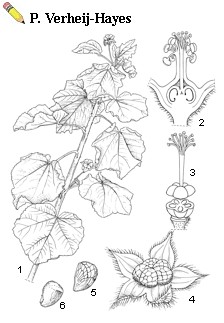 | Malachra capitata (L.) L. — 1, flowering branch; 2, vertical section through staminal column and pistil; 3, pistil with ovary in cross-section; 4, fruit in the calyx; 5, mericarp; 6, seed |
Growth and Development
Malachra capitata is a slow-growing plant. In Java Malachra capitata and Malachra fasciata flower year-round. In the Philippines Malachra fasciata flowers from September to January.
Other Botanical Information
Malachra capitata and Malachra fasciata are closely allied, which is reflected in the overlap of their vernacular names in the Philippines, where both are known under the names 'paang-baliwis' and 'bakembakes'. Sometimes Malachra alceifolia, here a synonym of Malachra capitata, is considered as a distinct species because its indumentum not only consists of minute stellate hairs as in typical Malachra capitata, but also of stiff, prickly, simple and stellate hairs. Differences in hairiness, which is a highly variable character depending mainly on circumstances, has led to numerous subclassifications without practical value.
Based on the degree of lobation of the leaves, 2 varieties have been distinguished in Malachra fasciata:
— var. fasciata: leaves 3—5-lobed, segments ovate to triangular to oblong, 1.5—2 cm wide; found in Indonesia (West Java, Timor, Irian Jaya) and the Philippines (Luzon, Panay).
— var. lineariloba (Turcz.) Gürke (synonym: M. lineariloba Turcz.): leaves deeply 3—7-parted, segments linear to long-lanceolate, 0.5—1.5 cm wide; known only from Indonesia (West Java, Madura, Timor) and the Philippines (Luzon, Mindoro, Panay, Mindanao).
Malachra L. is in need of a new taxonomic revision, as the last one of Gürke (1892) is badly out of date.
Based on the degree of lobation of the leaves, 2 varieties have been distinguished in Malachra fasciata:
— var. fasciata: leaves 3—5-lobed, segments ovate to triangular to oblong, 1.5—2 cm wide; found in Indonesia (West Java, Timor, Irian Jaya) and the Philippines (Luzon, Panay).
— var. lineariloba (Turcz.) Gürke (synonym: M. lineariloba Turcz.): leaves deeply 3—7-parted, segments linear to long-lanceolate, 0.5—1.5 cm wide; known only from Indonesia (West Java, Madura, Timor) and the Philippines (Luzon, Mindoro, Panay, Mindanao).
Malachra L. is in need of a new taxonomic revision, as the last one of Gürke (1892) is badly out of date.
Ecology
In South-East Asia Malachra is generally found in waste places, fallow land, and in grassland subject to annual burning. In India Malachra capitata often occurs on land that tends to be inundated during rains, but it also withstands the dry conditions between monsoons. It is frequently found with Cyperus rotundus L. In South-East Asia M. fasciata occurs in waste places and on roadsides at low altitudes, presumably under seasonally dry conditions. In the Philippines it is locally abundant in wet locations and it also grows as a weed in fallow rice fields. M. capitata is a short-day plant. When sown in April—June in India flowering starts in the middle of September, with April sowings giving the highest fibre yield. M. fasciata flowers from September to January in the Philippines.
Propagation and planting
Malachra can be propagated by seed and by cuttings. Seed germination of Malachra capitata is often poor because of its hard seed coat, but it can be improved by seed treatment, e.g. with sulphuric acid. Malachra capitata must be grown at close spacings and protected from strong winds.
Husbandry
Cultivated Malachra capitata requires little attention.
Diseases and Pests
Malachra capitata is a host plant of zucchini yellow mosaic virus (ZYMV), a virus causing much trouble in melon (Cucumis melo L.) and cucumber (Cucumis sativus L.).
Harvesting
In India Malachra capitata cultivated for fibre is harvested 3—4 months after planting.
Yield
Malachra capitata fibre yields of 1.9 t/ha have been obtained from experimental plantings in India. Natural stands of Malachra fasciata and Malachra capitata in the Philippines have been estimated to yield roughly about 0.2 t/ha and 1 t/ha of fibre, respectively.
Handling After Harvest
In the Philippines the fibre of Malachra fasciata is extracted by retting: the entire plant is cut and kept in fresh water for about 10 days, after which the bast is easily stripped and freed from the nonfibrous material by washing. In the Philippines Malachra capitata is sometimes made into cordage without retting: the bark is simply stripped from the plant, dried and twisted into cords. In India the roots and leaves are removed from harvested Malachra capitata and the green stems are retted for 6—8 days in small concrete tanks. The fibre is easily separated from the retted stems because the plants do not have many lateral branches.
Genetic Resources and Breeding
No germplasm collections or breeding programmes of Malachra are known to exist.
Prospects
Though Malachra capitata is a potential source of excellent jute-like fibre and adapted to a wider range of ecological conditions than jute, the present-day use of Malachra seems very limited. It is unlikely that its importance in South-East Asia will increase beyond the current usage as cordage material. Its noxious weedy nature in the United States will deter wider use.
Literature
Basu, N.C. & Bose, S., 1975. Effect of sowing time on the growth and yield of Malachra capitata L. Indian Journal of Agricultural Research 9(1): 43—50.
Basu, N.C. & Chakravarty, K., 1968. Malachra capitata L., with some special reference to its growth, yield attributes and some physical aspects of its fibre. Indian Journal of Agricultural Sciences 38(3): 550—561.
King, A.E.W., 1919. The mechanical properties of Philippine bast-fiber ropes. The Philippine Journal of Science 14(6): 561—694.
Maiti, R.K. & Basu, N.C., 1968. Fibre anatomy of Malachra capitata L., with special reference to its ultimate fibre and fibre tenacity. Indian Journal of Agricultural Sciences 38(4): 724—729.
Ragasa, C.Y., Peñalosa, B.A. & Rideout, J.A., 1998. A bioactive dipeptide derivative from Malachra fasciata (Malvaceae). Philippine Journal of Science 127(4): 267—276.
van Borssum Waalkes, J., 1966. Malesian Malvaceae revised. Blumea 4(1): 1—213.
Basu, N.C. & Chakravarty, K., 1968. Malachra capitata L., with some special reference to its growth, yield attributes and some physical aspects of its fibre. Indian Journal of Agricultural Sciences 38(3): 550—561.
King, A.E.W., 1919. The mechanical properties of Philippine bast-fiber ropes. The Philippine Journal of Science 14(6): 561—694.
Maiti, R.K. & Basu, N.C., 1968. Fibre anatomy of Malachra capitata L., with special reference to its ultimate fibre and fibre tenacity. Indian Journal of Agricultural Sciences 38(4): 724—729.
Ragasa, C.Y., Peñalosa, B.A. & Rideout, J.A., 1998. A bioactive dipeptide derivative from Malachra fasciata (Malvaceae). Philippine Journal of Science 127(4): 267—276.
van Borssum Waalkes, J., 1966. Malesian Malvaceae revised. Blumea 4(1): 1—213.
Author(s)
N.O. Aguilar & M. Brink
Correct Citation of this Article
Aguilar, N.O. & Brink, M., 2003. Malachra L.. In: Brink, M and Escobin, R.P. (Editors): Plant Resources of South-East Asia No 17: Fibre plants. PROSEA Foundation, Bogor, Indonesia. Database record: prota4u.org/prosea

All texts are licensed under a Creative Commons Attribution-Noncommercial-Share Alike 3.0 Netherlands License
This license does not include the illustrations (Maps,drawings,pictures); these remain all under copyright.