Record Number
6549
PROSEA Handbook Number
17: Fibre plants
Taxon
Miscanthus Andersson
Protologue
Öfvers. Förh. Kongl. Svenska Vetensk.-Akad. 12: 165 (1856).
Family
GRAMINEAE
Chromosome Numbers
x = 19; Miscanthus floridulus, Miscanthus sinensis: 2n = 38; Miscanthus possibly originated as an amphidiploid between species with x = 9 and x = 10
Major Taxa and Synonyms
`Major species and synonyms
— Miscanthus floridulus (Labill.) Warb. ex K. Schum. & Lauterb., Fl. Deut. Schutzgeb. Südsee: 166 (1901), synonyms: Saccharum floridulum Labill. (1824), Miscanthus japonicus Andersson (1856), Miscanthus formosanus A. Camus (1924).
— Miscanthus sinensis Andersson, Öfvers. Förh. Kongl. Svenska Vetensk.-Akad. 12: 166 (1856), synonyms: Saccharum japonicum Thunb. (1794, p.p.), Miscanthus purpurascens Andersson (1856), Miscanthus matsudae Honda (1923).
— Miscanthus floridulus (Labill.) Warb. ex K. Schum. & Lauterb., Fl. Deut. Schutzgeb. Südsee: 166 (1901), synonyms: Saccharum floridulum Labill. (1824), Miscanthus japonicus Andersson (1856), Miscanthus formosanus A. Camus (1924).
— Miscanthus sinensis Andersson, Öfvers. Förh. Kongl. Svenska Vetensk.-Akad. 12: 166 (1856), synonyms: Saccharum japonicum Thunb. (1794, p.p.), Miscanthus purpurascens Andersson (1856), Miscanthus matsudae Honda (1923).
Vernacular Names
General: miscanthus, silvergrass (En). Philippines: bilau (Igorot, Ifugao).
— Miscanthus floridulus: floret silvergrass (En). Indonesia: glagah (Javanese, Balinese)], toi (Halmahera), lolo (Ternate, Tidore). Philippines: bublung (Bontoc), buyao (Ifugao). Vietnam: c[or] ch[ef] v[ef].
— Miscanthus sinensis: eulalia (En). Indonesia: walana 'in cuntung (Minahasa). Philippines: rono (Ilokano), bigao (Bikol). Vietnam: ch[ef] v[ef] trung hoa.
— Miscanthus floridulus: floret silvergrass (En). Indonesia: glagah (Javanese, Balinese)], toi (Halmahera), lolo (Ternate, Tidore). Philippines: bublung (Bontoc), buyao (Ifugao). Vietnam: c[or] ch[ef] v[ef].
— Miscanthus sinensis: eulalia (En). Indonesia: walana 'in cuntung (Minahasa). Philippines: rono (Ilokano), bigao (Bikol). Vietnam: ch[ef] v[ef] trung hoa.
Origin and Geographic Distribution
Miscanthus originates from Asia and contains about 20 species, occurring in the Old World tropics, South Africa and East Asia. Miscanthus floridulus is distributed from East Asia through South-East Asia to Polynesia. Miscanthus sinensis is a more temperate zone species, native to China, Korea, Taiwan, Japan and eastern Russia, and introduced and established in Australia and North America. The extent of its distribution in South-East Asia is uncertain, but it seems to occur in the Philippines and Indo-China. Information on Miscanthus sinensis in Indonesia probably refers to Miscanthus floridulus. Both Miscanthus floridulus and Miscanthus sinensis are sometimes considered weeds.
Uses
The stems of Miscanthus floridulus and Miscanthus sinensis are suitable for thatching and widely used for this purpose, for instance in Indo-China, eastern Malaysia, the Moluccas, the Philippines, New Guinea, and the Pacific. They serve for making house walls in the Philippines and New Guinea. In the Philippines the stems are also made into fences, floor-coverings, coarse baskets, children's toys, novelty and souvenir items, supports for climbing vegetables or beans and drying racks for tobacco. In Luzon split stems serve for making screens and window shades. In the Moluccas and Papua New Guinea the stems are made into arrow shafts. Both Miscanthus floridulus and Miscanthus sinensis can be used for paper making.
Miscanthus shoots are eaten as a vegetable in East Kalimantan. The leaves are fodder for water buffaloes in the Philippines. The stems serve as fuel in the Philippines and Indo-China. Medicinal uses include the application of the juice or a decoction of Miscanthus on bites from wild animals in Indo-China, whereas in the Philippines a shoot decoction is taken against cough. In the Philippines Miscanthus stems with leaves are sometimes arranged in front of houses or other property as a sign not to enter or disturb.
Outside South-East Asia Miscanthus sinensis is widely planted as an ornamental, and also in hedges and windbreaks. In Japan it is cultivated as a forage plant and it has been used as a source of a yellow dye. Miscanthus floridulus is grown as an ornamental. In Taiwan it is planted as a shelter. Because of its high productivity, Miscanthus is being investigated in Europe as a renewable source of energy and a potential source of fibre for composite materials like MDF (medium density fibreboard) and chipboard, pulp for paper and packaging, biodegradable geotextiles (e.g. for temporary protection of slopes and banks), filters and sorbents, and insulation. Most research has focused on Miscanthus xgiganteus Greef & Deuter ex Hodkinson & Renvoize, which is probably an allotriploid hybrid of Miscanthus sinensis and Miscanthus sacchariflorus (Maxim.) Hack., originating from East Asia and introduced into Europe in the 1930s.
Miscanthus shoots are eaten as a vegetable in East Kalimantan. The leaves are fodder for water buffaloes in the Philippines. The stems serve as fuel in the Philippines and Indo-China. Medicinal uses include the application of the juice or a decoction of Miscanthus on bites from wild animals in Indo-China, whereas in the Philippines a shoot decoction is taken against cough. In the Philippines Miscanthus stems with leaves are sometimes arranged in front of houses or other property as a sign not to enter or disturb.
Outside South-East Asia Miscanthus sinensis is widely planted as an ornamental, and also in hedges and windbreaks. In Japan it is cultivated as a forage plant and it has been used as a source of a yellow dye. Miscanthus floridulus is grown as an ornamental. In Taiwan it is planted as a shelter. Because of its high productivity, Miscanthus is being investigated in Europe as a renewable source of energy and a potential source of fibre for composite materials like MDF (medium density fibreboard) and chipboard, pulp for paper and packaging, biodegradable geotextiles (e.g. for temporary protection of slopes and banks), filters and sorbents, and insulation. Most research has focused on Miscanthus xgiganteus Greef & Deuter ex Hodkinson & Renvoize, which is probably an allotriploid hybrid of Miscanthus sinensis and Miscanthus sacchariflorus (Maxim.) Hack., originating from East Asia and introduced into Europe in the 1930s.
Production and International Trade
Miscanthus floridulus and Miscanthus sinensis are used locally in South-East Asia. No production or trade statistics are available.
Properties
The ultimate fibres of Miscanthus have an average length of 1.4—1.8 mm, a lumen width of 7 µm and a cell wall thickness of 6 µm. Miscanthus straw contains 38—48% 'ALFA'-cellulose, 26—34% hemicelluloses, 18—24% lignin and 2—6% ash. The 'ALFA'-cellulose and lignin levels of 2-year-old plants decrease from the base to the top of the stem, whereas the opposite occurs for hemicelluloses and ash. The lignin content of the leaves is lower than that of the stem tops, and the ash content higher, whereas the levels of a-cellulose and hemicelluloses in the leaves are similar to those in the stem tops. When separated into a chip fraction (mainly consisting of splintered internodes) and meal fraction (mainly ground leaves, nodes and husks), the chip fraction did not give better pulp quality than unfractioned material. In a comparative study in the United Kingdom, chemical (soda-anthraquinone) Miscanthus pulps were superior in yield (46—52%), tensile strength and tear strength to those of wheat straw, but inferior in brightness. Yields and tensile strength were similar to those of chemical (kraft) Eucalyptus pulp, but the tear strength and brightness were superior. Semi-chemical (neutral sulphite semi-chemical process) Miscanthus pulp did not compare favourably with semi-chemical hardwood pulp. Particle boards made of Miscanthus material were much inferior to those made of wood, but Miscanthus showed promise as raw material for MDF. Another study showed that good quality particle boards can be made of Miscanthus provided the glue used is PMDI (polymeric diphenylmethane-4,4-diisocyanate) instead of UF (urea formaldehyde), PF (phenol formaldehyde) or MUPF (melamine urea phenol formaldehyde).
Though the leaves of Miscanthus floridulus are sometimes used as fodder and appear excellent on chemical analysis, they are not very suitable because of their harshness. The scabrid-toothed leaf margins of Miscanthus floridulus can make severe cuts. The yellow colouring substance in Miscanthus sinensis is probably tricin. The glycoprotein fraction of a water extract of Miscanthus sinensis spikelets inhibited cutaneous allergic reactions in experiments with mice, and may be useful in the development of anti-allergenic therapies. The energy content of Miscanthus is about 16—19 MJ/kg dry matter.
Though the leaves of Miscanthus floridulus are sometimes used as fodder and appear excellent on chemical analysis, they are not very suitable because of their harshness. The scabrid-toothed leaf margins of Miscanthus floridulus can make severe cuts. The yellow colouring substance in Miscanthus sinensis is probably tricin. The glycoprotein fraction of a water extract of Miscanthus sinensis spikelets inhibited cutaneous allergic reactions in experiments with mice, and may be useful in the development of anti-allergenic therapies. The energy content of Miscanthus is about 16—19 MJ/kg dry matter.
Adulterations and Substitutes
Numerous other plant species are used for thatching in South-East Asia, such as Imperata conferta (J.S. Presl) Ohwi and Imperata cylindrica (L.) Raeuschel. As a source of pulping material, Miscanthus mainly competes with hardwoods.
Description
Robust, tufted, rhizomatous, perennial grasses with erect, solid culms. Leaves expanded, sheathed, ligule membranous, ciliate, blade linear, flat. Inflorescence usually an open, large, plumose panicle with tough rachis, repeatedly branched on all sides into numerous racemes; spikelets in pairs, small, equal, lanceolate, unequally pedicellate, falling entire, 1-flowered, awned, with a spreading bundle of long silvery-white or coloured hairs at base; glumes equal, thin, 1—5-nerved; lemmas smaller, upper lemma with central nerve excurrent into long or short awn; palea nerveless; lower floret reduced to a sterile hyaline lemma, upper floret bisexual; lodicules 2, cuneate; stamens 2—3; styles 2, free; stigmas 2, plumose. Fruit a subcylindrical caryopsis.
— Miscanthus floridulus. A robust, tufted, erect, perennial grass, 1.5—3 m tall. Culm terete, filled with pith, glabrous, pruinose below the nodes. Leaf-sheath glabrous or outer margin with long hairs; ligule 1—2 mm tall; blade 60—150 cm x 1—4.5 cm, base attenuate, margins very rough, apex acute, long hairy above the base or only just behind the ligule, otherwise glabrous and smooth with wide midrib. Inflorescence 30—45 cm long; branches numerous, erect or nodding, lower ones 20—40 cm long, solitary or 2—6 together, often from near base already with 3—10 long, lateral branches; spikelets not crowded; pedicels slender, thickened upwards, those of a pair 2—4 mm and 4—9 mm long respectively, both, or at least the longer one, ultimately rather divergent or recurved; spikelet about 4 mm long; basal hairs 5—11 mm long, white or purple; lower glume 3—5-nerved, upper glume 3-nerved; lower lemma 2.2—4.2 mm long, finely ciliate in upper half, 0—1-nerved; upper lemma 2—3.5 mm long, 3-nerved, awn twisted, 6—11 mm long; palea 1.5—2.7 mm long; stamens 3; stigmas exserted near middle of spikelet.
— Miscanthus sinensis. A robust, tufted, erect, perennial grass, 1.5—2.5 m tall. Leaves radical and cauline; blade 50—80 cm x 0.2—2 cm, stiff, very scabrous on the margin, pale or slightly glaucous beneath, midrib thickened toward base. Inflorescence a corymbose panicle, 20—30 cm long, main axis shorter than the 7—many raceme-branches; racemes 15—30 cm long; spikelets as in Miscanthus floridulus but longer, 5—7 mm long, tuft of hairs 7—12 mm long, awn 8—15 mm long.
— Miscanthus floridulus. A robust, tufted, erect, perennial grass, 1.5—3 m tall. Culm terete, filled with pith, glabrous, pruinose below the nodes. Leaf-sheath glabrous or outer margin with long hairs; ligule 1—2 mm tall; blade 60—150 cm x 1—4.5 cm, base attenuate, margins very rough, apex acute, long hairy above the base or only just behind the ligule, otherwise glabrous and smooth with wide midrib. Inflorescence 30—45 cm long; branches numerous, erect or nodding, lower ones 20—40 cm long, solitary or 2—6 together, often from near base already with 3—10 long, lateral branches; spikelets not crowded; pedicels slender, thickened upwards, those of a pair 2—4 mm and 4—9 mm long respectively, both, or at least the longer one, ultimately rather divergent or recurved; spikelet about 4 mm long; basal hairs 5—11 mm long, white or purple; lower glume 3—5-nerved, upper glume 3-nerved; lower lemma 2.2—4.2 mm long, finely ciliate in upper half, 0—1-nerved; upper lemma 2—3.5 mm long, 3-nerved, awn twisted, 6—11 mm long; palea 1.5—2.7 mm long; stamens 3; stigmas exserted near middle of spikelet.
— Miscanthus sinensis. A robust, tufted, erect, perennial grass, 1.5—2.5 m tall. Leaves radical and cauline; blade 50—80 cm x 0.2—2 cm, stiff, very scabrous on the margin, pale or slightly glaucous beneath, midrib thickened toward base. Inflorescence a corymbose panicle, 20—30 cm long, main axis shorter than the 7—many raceme-branches; racemes 15—30 cm long; spikelets as in Miscanthus floridulus but longer, 5—7 mm long, tuft of hairs 7—12 mm long, awn 8—15 mm long.
Image
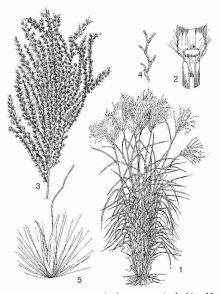 | Miscanthus sinensis Andersson – 1, habit Miscanthus floridulus (Labill.) Warb. ex K. Schum. & Lauterb. – 2, part of sheath with ligule; 3, inflorescence; 4, part of inflorescence branch axis; 5, spikelet |
Growth and Development
Miscanthus spp. are perennial grasses. The estimated productive life of Miscanthusxgiganteus is 10—20 years, but yields seem to decline after 10 years. Miscanthus follows the C4-cycle photosynthetic pathway, thus using CO2 and water more efficiently than C3 plants and having higher potential biomass yields. Daily growth rates up to 3—4 cm have been recorded. Unlike other C4-plants, e.g. maize (Zea mays L.), Miscanthus retains its high photosynthetic capacity at temperatures below 14?C. Miscanthus is wind-pollinated and in Java Miscanthus floridulus flowers throughout the year. Miscanthus roots extend to a depth of 1 m or deeper.
Other Botanical Information
Literature on Miscanthus is often unreliable at the species level because the taxonomy of Miscanthus is not clear and is in need of revision. Miscanthus sinensis, for instance, has sometimes been grouped under Miscanthus floridulus. However, based on isozyme analysis it has been postulated that Miscanthus floridulus evolved from the more primitive Miscanthus sinensis. Hybridization between the now approximately 20 recognized Miscanthus species is common and has given rise to a large number of hybrids, many of which are sterile. Miscanthus is closely related to Saccharum L. with which it is able to hybridize. A specimen in the Linnean Herbarium annotated as Saccharum officinarum L. later appeared to be Miscanthus floridulus.
The soft-leaved Miscanthus sinensis var. condensatus (Hack.) Makino (synonym: Miscanthus condensatus Hack., by some considered as a separate species) occurs on seashores and sometimes on mountains in Japan; it is often cultivated as a fodder plant in the Ryukyu and the Idzu Islands. It also occurs in Korea, China, Indo-China and the Pacific. Miscanthusxgiganteus is a hardy perennial 2.5—3.5 m tall; leaves flat and linear, usually more than 50 cm x 3 cm, ligule truncate with hairs; inflorescence 30 cm long with 15 cm long rachis; spikelets 4—6 mm long with tuft of hairs about 2 times longer; lower glume 5—6 mm long, upper glume 4—5 mm; sterile and fertile lemmas 3.5 mm long, not awned. Numerous, mainly ornamental Miscanthus cultivars are known, particularly of Miscanthus sinensis; they differ in size and colour of foliage and inflorescence. Some well-known Miscanthus sinensis cultivars are 'Goliath', 'Purpureus', 'Sarabande' and 'Zebrinus'.
Other Miscanthus species recorded from South-East Asia are Miscanthus nepalensis (Trin.) Hack., occurring in Malaysia (Pahang), India and Burma (Myanmar) and Miscanthus depauperatus Merr., found in the Philippines. No information is available on their uses. Miscanthus sacchariflorus (Maxim.) Hack. (synonym: Imperata sacchariflora Maxim.) is an important source of pulp for paper making in China and is under investigation as a biomass crop.
The soft-leaved Miscanthus sinensis var. condensatus (Hack.) Makino (synonym: Miscanthus condensatus Hack., by some considered as a separate species) occurs on seashores and sometimes on mountains in Japan; it is often cultivated as a fodder plant in the Ryukyu and the Idzu Islands. It also occurs in Korea, China, Indo-China and the Pacific. Miscanthusxgiganteus is a hardy perennial 2.5—3.5 m tall; leaves flat and linear, usually more than 50 cm x 3 cm, ligule truncate with hairs; inflorescence 30 cm long with 15 cm long rachis; spikelets 4—6 mm long with tuft of hairs about 2 times longer; lower glume 5—6 mm long, upper glume 4—5 mm; sterile and fertile lemmas 3.5 mm long, not awned. Numerous, mainly ornamental Miscanthus cultivars are known, particularly of Miscanthus sinensis; they differ in size and colour of foliage and inflorescence. Some well-known Miscanthus sinensis cultivars are 'Goliath', 'Purpureus', 'Sarabande' and 'Zebrinus'.
Other Miscanthus species recorded from South-East Asia are Miscanthus nepalensis (Trin.) Hack., occurring in Malaysia (Pahang), India and Burma (Myanmar) and Miscanthus depauperatus Merr., found in the Philippines. No information is available on their uses. Miscanthus sacchariflorus (Maxim.) Hack. (synonym: Imperata sacchariflora Maxim.) is an important source of pulp for paper making in China and is under investigation as a biomass crop.
Ecology
Miscanthus floridulus occurs in South-East Asia almost from sea-level up to 3000 m altitude, but mostly at 1000—2000 m. It is frequently found on rocky mountain slopes, in swampy locations and in waste or disturbed land. It also forms gregarious clumps and thickets in open sites in oak and secondary forest, tree-fern and bog grasslands. In Java Miscanthus floridulus is locally abundant in sunny or partly shaded, humid or sometimes marshy places, in forest edges, young forest, scrub vegetation and grass jungles, at 1350—2100 m altitude. Miscanthus floridulus is aggressive and can form dense communities. It survives fire through quick regeneration from subterranean parts. Miscanthus floridulus withstands wind and can grow in coastal areas where salt spray occurs. Miscanthus sinensis occurs at medium and higher altitudes in the Philippines. After repeated fires it may dominate areas completely.
Propagation and planting
Miscanthus is usually propagated vegetatively by division or rhizome cuttings. Rhizome cuttings for field planting are usually 8—15 cm long and can be stored between —1°C and 1°C. Not much success has been obtained with stem cuttings. Miscanthus floridulus and Miscanthus sinensis can be propagated by seed, though seed production has been difficult for Miscanthus floridulus in China and for some Miscanthus sinensis cultivars. The germination rate of Miscanthus floridulus increases with temperature between 15°C and 35°C, but the germination percentage is not affected by temperature in this range. The optimum temperature range for germination of Miscanthus sinensis seed is 20—30°C. In vitro micropropagation of various Miscanthus sinensis cultivars is possible with immature inflorescences on modified Murashige and Skoog (MS) medium with 9.0 µmol 2,4-D (2,4-dichlorophenoxyacetic acid) and 20 g/l sucrose, with organogenesis occurring 8—12 weeks after callus formation. Shoots can be rooted on half-strength MS medium and tillers will form, which can be separated for new rooting and tillering. Another micropropagation system for Miscanthus sinensis has been developed in which meristem tissue is removed from selected plants and cultured.
In Europe the practically sterile hybrid Miscanthus xgiganteus is propagated vegetatively by rhizome cuttings or in vitro micropropagation and planted at a density of 5 000—40 000 plants per ha.
In Europe the practically sterile hybrid Miscanthus xgiganteus is propagated vegetatively by rhizome cuttings or in vitro micropropagation and planted at a density of 5 000—40 000 plants per ha.
Husbandry
In South-East Asia Miscanthus is not planted but collected from the wild. Cultivated Miscanthus xgiganteus in Europe needs to be weeded in the establishment phase (the first 2 years), but later on the crop is competitive enough to overcome weeds. Because of the high productivity, and in spite of the high water-use efficiency, the water requirement is high and irrigation is beneficial under southern European conditions. The response to fertilizer application varies with soil type, but in general the nutrient removal at harvesting is relatively low: 5—8 kg N, 0.5—1.5 kg P and 6—9 kg K per t harvested dry matter.
Diseases and Pests
Miscanthus is attacked by rusts (Puccinia spp.), a wide-ranging species being Puccinia miscanthae, and smuts (Sphacelotheca spp. and Ustilago spp.). In Europe it is attacked by the Miscanthus streak virus. No information is available on diseases and pests affecting Miscanthus in South-East Asia.
Harvesting
In Europe Miscanthus xgiganteus is harvested annually after nutrients have relocated to the rhizomes and the plants have dried to a dry matter content of at least 60%, and before new shoots occur. In northern Europe this is preferably in February or March, and in southern Europe in November. If it is harvested early, the biomass loss is low, but the moisture content is high. If it is harvested late, the moisture content is low, but biomass loss of up to 20% may occur. For the production of handicrafts in the Philippines, young stems are preferred.
Yield
Miscanthus yields in South-East Asia are unknown, but for China possible dry matter yields of up to 40 t/ha have been recorded. In Europe Miscanthus yields from the third year onwards normally range from less than 10 t/ha dry matter per year in northern Europe to about 25 t/ha dry matter per year in southern Europe under irrigated conditions. Experimental yields up to 41 t/ha dry matter have been recorded.
Handling After Harvest
The stem is the most important part of Miscanthus as a source of fibre, and after harvest the stems must be separated from the leaves. In Indonesia the traditional way of preparing Miscanthus stems is to separate them and dry them in the sun. Young stems or shoots to be used for medicinal purposes are not dried.
Genetic Resources
Miscanthus floridulus and Miscanthus sinensis have a wide distribution and do not seem to be threatened with extinction. Some 14 accessions of Miscanthus floridulus are held at the Institute of Plant Breeding of the College of Agriculture UPLB in Laguna, the Philippines. Accessions of Miscanthus sinensis are held in Japan (Kumamoto Station National Livestock Breeding Centre, Kumamoto) and the United Kingdom (Institute of Grassland and Environmental Research, Aberystwyth).
Breeding
In Europe some Miscanthus breeding work has been started, for instance on hybridization and polyploidization. Furthermore, Miscanthus sinensis and Miscanthus xgiganteus genotypes are evaluated with respect to biomass yield, responses to low temperatures and frost tolerance. Miscanthus species are used in breeding programmes of sugar cane (Saccharum officinarum L.), e.g. for bringing in disease resistance.
Prospects
In South-East Asia Miscanthus will remain an important source of thatch. In the Philippines it is considered to have bright prospects as a material for handicrafts. Worldwide, it has potential as a non-wood source of fibre for composites such as MDF and pulp for paper making and packaging. Because of its high productivity, Miscanthus is a promising renewable source of energy.
Literature
el Bassam, N., 1998. Energy plant species: their use and impact on environment and development. James & James (Science Publishers) Ltd., London, United Kingdom. pp. 181—188.
Gawel, N.J., Robacker, C.D. & Corley, W.L., 1990. In vitro propagation of Miscanthus sinensis. HortScience 25(10): 1291—1293.
Hague, J.R.B., 1997. Biomass as feed-stocks for the forest products industry. In: Bullard, M.J., Ellis, R.G., Heath, M.C., Knight, J.D., Lainsbury, M.A. & Parker, S.R. (Editors): Biomass and energy crops. 7—8 April 1997, Royal Agricultural College, Cirencester. Aspects of Applied Biology No 49. The Association of Applied Biologists, Wellesbourne, United Kingdom. pp. 455—464.
Hodkinson, T.R., Chase, M.W., Takahashi, C., Leitch, I.J., Bennett, M.D. & Renvoize, S.A., 2002. The use of DNA sequencing (ITS and trnL-F), AFLP, and fluorescent in situ hybridization to study allopolyploid Miscanthus (Poaceae). American Journal of Botany 89: 279—286.
Lazarides, M., 1980. The tropical grasses of Southeast Asia (excluding bamboos). Phanerogamarum monographiae. Vol. 12. J. Cramer, Vaduz, Liechtenstein. p. 58.
Lewandowski, I., Kicherer, A. & Vonier, P., 1995. CO2-balance for the cultivation and combustion of Miscanthus. Biomass and Bioenergy 8(2): 81—90.
Ohwi, J., 1965. Flora of Japan. Smithsonian Institution, Washington, United States. pp. 188—189.
Walker, E.H., 1976. Flora of Okinawa and the southern Ryukyu Islands. Smithsonian Institution Press, Washington D.C., United States. p. 58.
Gawel, N.J., Robacker, C.D. & Corley, W.L., 1990. In vitro propagation of Miscanthus sinensis. HortScience 25(10): 1291—1293.
Hague, J.R.B., 1997. Biomass as feed-stocks for the forest products industry. In: Bullard, M.J., Ellis, R.G., Heath, M.C., Knight, J.D., Lainsbury, M.A. & Parker, S.R. (Editors): Biomass and energy crops. 7—8 April 1997, Royal Agricultural College, Cirencester. Aspects of Applied Biology No 49. The Association of Applied Biologists, Wellesbourne, United Kingdom. pp. 455—464.
Hodkinson, T.R., Chase, M.W., Takahashi, C., Leitch, I.J., Bennett, M.D. & Renvoize, S.A., 2002. The use of DNA sequencing (ITS and trnL-F), AFLP, and fluorescent in situ hybridization to study allopolyploid Miscanthus (Poaceae). American Journal of Botany 89: 279—286.
Lazarides, M., 1980. The tropical grasses of Southeast Asia (excluding bamboos). Phanerogamarum monographiae. Vol. 12. J. Cramer, Vaduz, Liechtenstein. p. 58.
Lewandowski, I., Kicherer, A. & Vonier, P., 1995. CO2-balance for the cultivation and combustion of Miscanthus. Biomass and Bioenergy 8(2): 81—90.
Ohwi, J., 1965. Flora of Japan. Smithsonian Institution, Washington, United States. pp. 188—189.
Walker, E.H., 1976. Flora of Okinawa and the southern Ryukyu Islands. Smithsonian Institution Press, Washington D.C., United States. p. 58.
Author(s)
A.T. Karyawati & D. Darmakusuma
Correct Citation of this Article
Karyawati, A.T. & Darmakusuma, D., 2003. Miscanthus Andersson. In: Brink, M and Escobin, R.P. (Editors): Plant Resources of South-East Asia No 17: Fibre plants. PROSEA Foundation, Bogor, Indonesia. Database record: prota4u.org/prosea

All texts are licensed under a Creative Commons Attribution-Noncommercial-Share Alike 3.0 Netherlands License
This license does not include the illustrations (Maps,drawings,pictures); these remain all under copyright.