Record Number
6553
PROSEA Handbook Number
17: Fibre plants
Taxon
Phragmites vallatoria (Pluk. ex L.) J.F. Veldkamp
Protologue
Blumea 37: 233 (1992).
Family
GRAMINEAE
Chromosome Numbers
2n = 36, 38, 48
Synonyms
Arundo vallatoria Pluk. ex L. (1754), Arundo karka Retz. (1786), Phragmites karka (Retz.) Steudel (1840).
Vernacular Names
Reed (En). Roseau (Fr). Indonesia: perumpung (general), bayongbong (Sundanese), glagah asu (Javanese). Malaysia: tebuh salah, terupuk (Dusun). Papua New Guinea: tiktik (Pidgin). Philippines: tambo (Tagalog, Bisaya, Bikol), tanubung (Bontoc), lupi (Bikol). Burma (Myanmar): kyu-phyu. Thailand: yaa khaem (Prachin Buri), yaa lang po (Trang). Vietnam: s[aaj]y n[us]i.
Origin and Geographic Distribution
Phragmites vallatoria has a very wide distribution and occurs in wetlands throughout the Old World tropics, from Senegal to Eritrea and Madagascar, and from Yemen through South and South-East Asia to the Philippines and Japan. It is also widespread in northern Australia, Papua New Guinea and Polynesia. Phragmites vallatoria is sometimes considered a weed, e.g. in lakes in West Java and in irrigation tanks in Thailand.
Uses
The culms of Phragmites vallatoria are used as thatch and are made into wickerwork, for instance in Indonesia, the Philippines and Vietnam. In the Philippines and Indo-China bundled culms with panicles serve as brooms. The best grade brooms are made of culms with very young panicles. In the Philippines the culms are also used for whistles used during periods of mourning, and for making children's toys. In the Philippines leaves of Phragmites vallatoria are used as fertilizer for ponds. In Asia and Africa young shoots are eaten, mainly in times of famine. Young shoots also make good fodder. Phragmites vallatoria is planted in cleaning basins to treat mainly domestic waste water. It can be used for soil stabilization. In Assam (India) culm sections are worn in the ears of women and short sections are dyed violet and yellow and strung as beads.
Production and International Trade
No production statistics for Phragmites vallatoria exist. It is not traded internationally.
Properties
Oven-dry reed (culm with inflorescences) of Phragmites vallatoria contains about 55% cellulose (Cross and Bevan method), 27% lignin and 3% ash. Pulps suitable for writing and printing paper can be obtained from the reed with the soda or sulphate process, with a bleached pulp yield of about 40%. The fibres in the pulp are (0.5—)1.2(—3.2) mm long and (6.6—)11.6(—19.8) µm wide. Because of the shortness of the fibres Phragmites vallatoria pulps have to be mixed with long-fibre pulps to be used in commercial paper machines.
Pilot projects in Indonesia (Bandung) and India have shown that constructed wetlands planted with Phragmites vallatoria are highly efficient in treating household sewage under tropical conditions. Under laboratory conditions it has been shown to absorb chromium efficiently from tannery effluents and sludge.
Pilot projects in Indonesia (Bandung) and India have shown that constructed wetlands planted with Phragmites vallatoria are highly efficient in treating household sewage under tropical conditions. Under laboratory conditions it has been shown to absorb chromium efficiently from tannery effluents and sludge.
Adulterations and Substitutes
In the Philippines Phragmites brooms may be replaced by brooms made of Thysanolaena latifolia (Roxb. ex Hornem.) Honda (synonym: Thysanolaena maxima (Roxb.) Kuntze), which are more durable and expensive.
Description
A robust, erect, strongly tufted, perennial grass (reed) up to 8 m tall, often with an extensive, creeping, branching rhizome or stolon up to 20 m long. Culm 2—8 m tall and 1.5 cm in diameter, very stout, often woody and bamboo-like with hollow internodes and glabrous nodes. Leaves sheathed on flowering culm; sheath glabrous or sparsely hairy and ciliate at the top; ligule very short, represented by a narrow, minutely ciliate rim; blade linear, 20—80 cm x 1—4 cm, base broad, margin smooth or rough, apex stiff and tapering-acute, glabrous above, scabrid beneath towards the apex, usually with 2—3 shallow depressions caused by pressure of mouths of older sheaths. Inflorescence a loose panicle, 20—75 cm long with a rather robust central axis and repeatedly branched, thin, rough, erect or nodding branches which are crowded in groups; pedicel 2—10 mm long; spikelets 3—7-flowered, 10—12 mm long, rachilla with numerous, thin, white-silvery hairs 4—8 mm long; lowermost floret sterile or male and persistent, succeeding florets bisexual and disarticulating below each fertile floret; glume boat-shaped, ovate-lanceolate, 3—4.5 mm long, 3(—5)-veined, acute, awnless, upper glume larger than lower one; lemma narrowly elliptic, 7—12 mm long; palea 2.5—3 mm long, scabrid on the veins; stamens 2 or 3; pistil with stipitate ovary, 2 styles with plumose stigmas exserted laterally near the base of the spikelet. Fruit a caryopsis, crowned by the stylar base.
Image
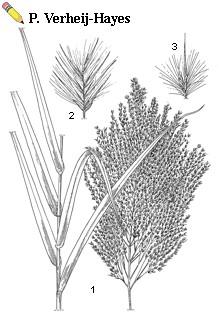 | Phragmites vallatoria (Pluk. ex L.) J.F. Veldkamp - 1, habit of leafy culm and inflorescence; 2, spikelet; 3, floret |
Growth and Development
The leaves of Phragmites vallatoria have movable sheaths so that all leaves turn leeward in the wind. In Java Phragmites vallatoria flowers throughout the year. It spreads by its creeping rhizomes (underground) or stolons (aboveground). In natural stands in Rajasthan (India) the standing aboveground dry biomass was 4.2—6.7 kg/m2, and the underground biomass 0.8—1.2 kg/m2.
Other Botanical Information
Phragmites Adans. comprises 3 or 4 species of aquatic or semi-aquatic reeds which are distributed worldwide. They are all extremely closely related and can only be distinguished by minor, disputable characteristics. Phragmites vallatoria is most similar to, and has often been confused with, Phragmites australis (Cav.) Trin. ex Steudel (synonyms: Phragmites communis Trin., Phragmites vulgaris (Lamk) Crépin), which mostly occurs in temperate regions. Phragmites vallatoria can be distinguished by its rough stiff-pointed leaves, its spikelets with an acute upper glume, and rather shorter and less dense rachilla hairs. In the literature Phragmites vallatoria is better known by its synonym Phragmites karka. Because of the similarity of Phragmites australis and Phragmites vallatoria, information on individual species cannot be trusted absolutely.
Ecology
Phragmites vallatoria is found in tropical and subtropical regions in marshy or seasonally flooded soils and moist locations, such as river banks. It occurs in fresh and brackish water. In Indonesia it occurs from sea-level up to 1700(—2200) m altitude. In shallow fresh water it is often the dominant species growing in association with Alternanthera spp., Colocasia spp., Hydrilla verticillata (L.f) Royle and Nymphaea spp., and with floating plants such as Eichhornia crassipes (Martius) Solms, Salvinia molesta D.S. Mitchell, S. natans (L.) All. and Pistia stratiotes L. In shallow waters Phragmites vallatoria can form extensive masses of vegetation which are important feeding and breeding grounds for fish. However, tree seeds from the surrounding forest may germinate in these reed masses leading to progressive expansion of the forest into the wetland. Phragmites vallatoria plays an important role in the rehabilitation of tin tailings in Malaysia. Part of these tailings consist of former 'slime retention areas' and are characterized by very heavy clay soils. The first vegetation, in which Nelumbo and Typha spp. dominate, is followed by a shrub stage which is initiated by the establishment of Phragmites vallatoria. Cyclosorus, Emilia, Lycopodium, Nephrolepis and Pteris spp. complement this community. If there are repeated deposits of fresh slime, all species except Phragmites vallatoria are buried and the succession starts again. If undisturbed the Phragmites vallatoria community gradually gives way to forest, initially characterized by Bridelia, Ficus, Muntingia and Psidium spp. Phragmites vallatoria may become a weed in irrigation systems and rice fields.
Propagation and planting
Phragmites vallatoria can be propagated by division and by seed. A procedure has been developed for the large-scale micropropagation of Phragmites vallatoria from axillary buds, with buds from the lower and middle culm giving better results than those from the upper third. Multiple shoot formation and root initiation occurred on Murashige and Skoog (MS) basal medium supplemented with 0.5 mg/l benzyladenine (BA), 0.5 mg/l kinetin and 2% sucrose. Shoots and roots elongated after transfer to half-strength MS basal medium with 2% sucrose but without any plant growth regulators. About 10 000 plants were produced from 3 buds within 9 months.
Husbandry
Phragmites vallatoria tolerates some grazing, but under heavy grazing it is replaced by less palatable species.
Yield
No information is available on the yield of Phragmites vallatoria in South-East Asia. A uniform stand of Phragmites vallatoria in a constructed wetland system for wastewater treatment in central India produced about 12 kg/m2 dry biomass within 1 year, of which about 11 kg/m2 was aboveground.
Handling After Harvest
The culms of Phragmites vallatoria may be split before being used for thatching. In Kudus (Java) the culms are flattened with a hammer, halved, dried and scraped before being used for very coarse wickerwork. In the Philippines brooms are made by tightly binding the culms to a central piece of bamboo or wood about 2 cm in diameter, with the panicles arranged in a fan-like manner.
Genetic Resources
A few germplasm accessions of Phragmites vallatoria are included in collections of Saccharum L. in India.
Prospects
Where large natural stands exist, Phragmites vallatoria will probably remain a source of thatch and material for wickerwork. It is likely that it will become more important in the biological treatment of sewage and industrial effluents.
Literature
Bhat, R.V. & Virmani, K.C., 1952. Indigenous cellulosic raw materials for the production of pulp, paper and board. Part 7. Writing and printing papers from Phragmites karka, Trin. Indian Forester 78: 127—137.
Gilliland, H.B., 1971. A revised flora of Malaya: an illustrated systematic account of the Malayan flora, including commonly cultivated plants. Vol. 3. Grasses of Malaya. Botanic Gardens, Singapore. pp. 49—51.
Palaniappan, V.M., 1974. Ecology of tin tailings areas: plant communities and their succession. Journal of Applied Ecology 11: 133—150.
Poonawala, I.S., Jana, M.M. & Nadgauda, R.S., 1999. Factors influencing bud break and rooting and mass-scale micropropagation of three Phragmites species: P. karka, P. communis and P. australis. Plant Cell Reports 18(7—8): 696—700.
Sharma, K.P., Kushwaha, S.P.S. & Gopal, B., 1998. A comparative study of stand structure and standing crops of two wetland species, Arundo donax and Phragmites karka, and primary production in Arundo donax with observations on the effect of clipping. Tropical Ecology 39(1): 3—14.
Veldkamp, J.F., 1992. Miscellaneous notes on Southeast Asian Gramineae. Blumea 37: 227—237.
Gilliland, H.B., 1971. A revised flora of Malaya: an illustrated systematic account of the Malayan flora, including commonly cultivated plants. Vol. 3. Grasses of Malaya. Botanic Gardens, Singapore. pp. 49—51.
Palaniappan, V.M., 1974. Ecology of tin tailings areas: plant communities and their succession. Journal of Applied Ecology 11: 133—150.
Poonawala, I.S., Jana, M.M. & Nadgauda, R.S., 1999. Factors influencing bud break and rooting and mass-scale micropropagation of three Phragmites species: P. karka, P. communis and P. australis. Plant Cell Reports 18(7—8): 696—700.
Sharma, K.P., Kushwaha, S.P.S. & Gopal, B., 1998. A comparative study of stand structure and standing crops of two wetland species, Arundo donax and Phragmites karka, and primary production in Arundo donax with observations on the effect of clipping. Tropical Ecology 39(1): 3—14.
Veldkamp, J.F., 1992. Miscellaneous notes on Southeast Asian Gramineae. Blumea 37: 227—237.
Author(s)
L.P.A. Oyen
Correct Citation of this Article
Oyen, L.P.A., 2003. Phragmites vallatoria (Pluk. ex L.) J.F. Veldkamp. In: Brink, M and Escobin, R.P. (Editors): Plant Resources of South-East Asia No 17: Fibre plants. PROSEA Foundation, Bogor, Indonesia. Database record: prota4u.org/prosea

All texts are licensed under a Creative Commons Attribution-Noncommercial-Share Alike 3.0 Netherlands License
This license does not include the illustrations (Maps,drawings,pictures); these remain all under copyright.