Record Number
6561
PROSEA Handbook Number
17: Fibre plants
Taxon
Urena lobata L.
Protologue
Sp. pl.: 692 (1753).
Family
MALVACEAE
Chromosome Numbers
2n = 28, 56
Vernacular Names
Congo jute, aramina, urena (En). Grand cousin, cousin urène, cousin rouge (Fr). Brunei: anca-anca, jerupang. Indonesia: pulutan (Javanese), pungpulutan (Sundanese), pulut (Sumatra). Malaysia: pulut-pulut, pepulut, pulut lembu. Philippines: kulotan (Tagalog, Bisaya), kollokollot (Ilokano), molopolo (Pampango, Tagalog). Cambodia: daem chruk. Laos: nha ngum. Thailand: khamong dong (northern), po seng (peninsular), khee khrok (central). Vietnam: (c[aa]y) k[es] hoa d[af]o, b[as]i l[uw][ow]ng, k[es] d[aaf]u ng[uwj]a.
Origin and Geographic Distribution
The origin of Urena lobata is not certain, but it is probably of Asiatic or African origin. It is now widely distributed in a wild or naturalized state throughout the tropics and subtropics, including South-East Asia. Urena lobata is grown as a fibre crop in mainland Africa, Madagascar, Brazil and India. It can be a troublesome weed, especially in pastures.
Uses
The bast fibre from wild or cultivated Urena lobata is widely used as a local source of cordage and coarse textiles and industrially as a substitute for jute (Corchorus spp.), e.g. for making sacks, carpets, cordage and upholstery. It is often used mixed with jute. In South-East Asia Urena lobata serves for making string, twines, ropes etc., for instance in Malaysia, Cambodia and New Guinea. In northern Thailand it is a source of fibre for the hill tribes. In Indramayu (West Java) at the beginning of the 20th Century sacks and mats were made of fibre from wild Urena lobata. The fibre of Urena lobata can be made into strong paper and whole plant cuttings can be pulped as well.
The main medicinal applications of Urena lobata in South-East Asia are the use of the juice of leaves or roots against bowel complaints, gonorrhoea and malaria, and leaf poultices on wounds, swellings and skin diseases. Young shoots and leaves are eaten as a vegetable. Animals eat the foliage. In Malaysia Urena lobata is considered a magic plant, used in healing rites, for protection, and in wedding and rice ceremonies.
The main medicinal applications of Urena lobata in South-East Asia are the use of the juice of leaves or roots against bowel complaints, gonorrhoea and malaria, and leaf poultices on wounds, swellings and skin diseases. Young shoots and leaves are eaten as a vegetable. Animals eat the foliage. In Malaysia Urena lobata is considered a magic plant, used in healing rites, for protection, and in wedding and rice ceremonies.
Production and International Trade
Recent production and trade statistics of Urena lobata are not available. In the 1970s the world production was estimated at 38 000 t per year, with about 70% produced in Brazil.
Properties
Fresh stems of Urena lobata yield 5—5.5(—7)% retted bast fibre. The fibre is fine, soft, flexible and lustrous, with a creamy white or pale yellow colour. It resembles jute more than other jute substitutes, such as kenaf (Hibiscus cannabinus L.) and roselle (Hibiscus sabdariffa L.). It can be spun on jute machinery without any change to the machines and without the operators needing experience with Urena lobata. The ultimate fibre cells are (0.8—)1.4—1.8(—5.9) mm long, with a diameter of (9—)12—19(—34) µm. Information on the fibre composition shows a wide variation in cellulose (63—87%) and lignin (7—12%) contents. Fibre from wild plants is usually only about 1 m long, whereas fibre from cultivated plants has an average length of about 2 m. In the Philippines rope made of Urena lobata fibre is considered unsuitable for wet conditions, because of the lower wet strength and the fact that it deteriorates rapidly. Kraft pulping experiments with Urena lobata bark and pith in South Africa gave pulp yields of 43—47%.
The seeds yield 7—18% oil, with linoleic acid, palmitic acid and oleic acid as major fatty acids, but also containing the cyclopropenoid fatty acids malvalic acid and sterculic acid. However, concentrations of the different compounds vary widely. The aerial parts contain the flavonol quercetin. A methanolic extract of Urena lobata roots has shown antibacterial activity against a range of microorganisms.
The 1000-seed weight is 15—30 g.
Adulterations and Substitutes
Urena lobata has to compete mainly with jute, kenaf and roselle. It is as fine and supple as jute, but not as strong. It has about the same colour and lustre as kenaf and roselle, and is finer, but less strong and durable.
Description
A highly variable annual or perennial shrub; in its weedy forms low, spreading and branching, 0.5—2.5 m tall, cultivated forms erect, poorly branched, up to 4 m or taller; all aboveground parts more or less densely covered with minute stellate hairs, usually also with scattered, thin, purple tinged simple hairs. Taproot short (20—25(—40) cm) with lateral roots up to 2 m long. Leaves alternate, simple, extremely variable in size and shape; stipules lanceolate to obovate, 2—4 mm long, acute, caducous; petiole 0.2—12 cm long; blade ranging from coarsely toothed lanceolate, orbicular or broadly ovate to shallowly or deeply palmately 3—7-lobed, 1—12 cm x 0.5—13 cm, base cordate to cuneate, margins serrate to crenate, apex rounded to acuminate, at base with 3—9 palmately arranged veins, surfaces densely stellate hairy, with 1—3 linear nectaries near the base of the main veins beneath. Inflorescence usually composed of solitary, axillary flowers, sometimes in clusters of 2—3, in the upper part flowers seemingly arranged in spikes or racemes because of the much reduced leaves. Flowers 5-merous, campanulate, 2—3 cm in diameter, pink with a purple centre; pedicel 1—7 mm long; epicalyx campanulate to tubular, 7—8 mm x 5—6 mm, closely enveloping the calyx and at base adnate to it, at apex with 5 long-triangular teeth 3—5 mm x 1—3 mm; calyx tubular to campanulate, 5—6 mm x 1.5—2 mm, at apex with 5 ovate to acuminate lobes 4—6 mm x 1.5—2 mm, at about one-third from the base of the slightly prominent calyx veins a nectary or a thickening only is present; petals obovate, 1.5 cm long, apex rounded; stamens arranged into a staminal column 10—14 mm long, usually curved, anthers in upper half, purple, pollen white; pistil with 5-carpelled ovary, style in the centre of the staminal column, at the apex divided into 10 arms each 1 mm long, stigmas 10, capitate, papillose, dark purple. Fruit a subglobular schizocarp, composed of 5 trigonous, indehiscent, 1-seeded mericarps, 4—5 mm long, covered with barbed bristles and a thick cover of stellate hairs. Seed reniform, 2.5—3.5 mm long, minutely hairy to glabrous, brown. Seedling with epigeal germination.
Image
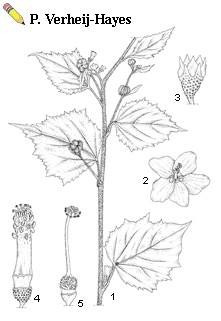 | Urena lobata L. - 1, flowering and fruiting branch; 2, flower; 3, epicalyx and calyx; 4, staminal column with pistil; 5, pistil |
Growth and Development
Cleaned and scarified seed may germinate within 5—8 days, but germination of unhusked seed may take place over a period of 2.5 months. The growth rate during the first month is slow, but subsequent growth is fast. The time to flowering depends on photoperiod, with the time to flowering being delayed by long photoperiods and the minimum vegetative period varying with genotype. In Selangor (Peninsular Malaysia) flowering and seed set of Urena lobata sown in May started at about 55 days and 105 days, respectively. In Java wild Urena lobata flowers throughout the year. Flowering occurs over a prolonged period and one node may bear all stages from flower buds to ripe fruits simultaneously. The flowers open early in the morning and wither about noon. They are capable of self-pollination, but the large intraspecific variation suggests a rather high percentage of cross-pollination. The nectaries are frequently visited by ants, aphids and various Hymenoptera. Dispersal is aided by the fruits' barbed spines which stick to clothes and to the coats of animals.
Other Botanical Information
The taxonomy of Urena L. has not yet been settled. Some consider Urena a monotypic genus with Urena lobata as one polymorphic species, whereas others recognize more species. In this account the one-species approach has been followed. Within Urena lobata s.l. 2 sharply distinct subspecies have been distinguished, based mainly on the form of the epicalyx:
— subsp. lobata, a stout plant with many ovate to lanceolate leaves, lower leaves shallowly lobed, and with a stiff, cupular epicalyx during fruiting, segments long-triangular, 4.5—5 mm x 2.5—3 mm, especially occurring above 400 m altitude; subdivided into var. lobata (syn. U. tomentosa Blume, Urena monopetala Lour.), with the green parts more or less densely pubescent with matted wool, and var. viminea (Cav.) Gürke, with the green parts more or less densely pubescent with often slightly scabrous hairs;
— subsp. sinuata (L.) Borss. Waalk., with lower leaves angular to palmately lobed or more deeply incised, and a spreading or reflexed, flexible epicalyx during fruiting, segments linear to lanceolate, acute, 3—4 mm x 1—1.5 mm, especially occurring below 400 m altitude; subdivided into var. sinuata (syn. Urena sinuata L., Urena procumbens L.), with palmatifid to palmatipartite leaves, and var. glauca (Blume) Borss. Waalk. (syn. Urena scabriuscula DC.), with angular to palmatilobate leaves.
Urena is morphologically very close to Pavonia Cav., which has mericarp bristles that are not barbed or with 3 hairy awns and leaves normally without nectaries. It is argued by several authors that the two genera should be merged.
Ecology
For optimal growth and fibre production Urena lobata needs a hot and humid climate with ample sunlight and rainfall, and a deep, fertile, well-drained soil. It prefers an average temperature of 21—27°C, a relative humidity of 73—85%, and a monthly rainfall of 160—210 mm during the growing season. Under less optimal conditions it may grow as a short, branched, wiry shrublet. Urena lobata needs short days for flowering.
In South-East Asia Urena lobata is common on roadsides and in waste places, fallow fields, plantations, secondary vegetation, teak-forests, and degraded peat-swamp forest, up to 2000 m altitude.
In South-East Asia Urena lobata is common on roadsides and in waste places, fallow fields, plantations, secondary vegetation, teak-forests, and degraded peat-swamp forest, up to 2000 m altitude.
Propagation and planting
Urena lobata is propagated by seed. Germination can be slow or uneven because of dormancy due to the impermeability of the testa to water. It is considerably improved by scarification, for instance through removal of part of the testa or treatment with concentrated sulphuric acid. Urena lobata is usually sown at the beginning of the rainy season in a well-prepared seedbed. Plants are closely spaced to prevent branching. Plant densities are usually around 300 000 plants/ha. Sowing may be done in rows (1—2 cm deep) or the seed may be broadcast.
In the wild state Urena lobata is a perennial, but it is usually grown as an annual crop. In some areas it is grown as a perennial and ratooned. Because of the high nutrient uptake it is recommended that Urena lobata be grown in rotation.
In the wild state Urena lobata is a perennial, but it is usually grown as an annual crop. In some areas it is grown as a perennial and ratooned. Because of the high nutrient uptake it is recommended that Urena lobata be grown in rotation.
Husbandry
Weeding of Urena lobata is necessary in the early growth stages and is usually done twice; the crop may be thinned at the same time. Urena lobata has a high nutrient demand. The nutrient uptake per hectare by a crop producing 40 t/ha green material has been estimated at 190 kg N, 24 kg P, 175 kg K and 148 kg Ca, of which 53%, 46%, 36% and 58%, respectively, is stored in the leaves. Therefore, returning the leaves to the soil helps to maintain soil fertility.
Diseases and Pests
Urena lobata can be seriously damaged by several fungi that form stem lesions ('stem canker'). The most widespread of these fungi are Botrytis cinerea and Macrophoma urenae. Another disease is damping-off or seedling blight caused by Fusarium spp. In India Urena lobata is attacked by Corynespora callicioidea, resulting in scattered, yellowish-red, irregular lesions on the leaves, with a black centre that develops into a hole. The fungal diseases can be controlled by treating seed with fungicides and by crop rotation. Urena lobata is an alternate host for the okra mosaic virus.
Urena lobata is attacked by some serious pests of cotton (Gossypium spp.), kenaf, roselle and ramie (Boehmeria nivea (L.) Gaudich.), such as cotton stainers (Dysdercus spp.) and leaf rollers (Sylepta spp.). Dysdercus superstitiosus can strongly reduce the viability of Urena lobata seeds, but the fibre yield is unaffected. In Java (Indonesia) and India it is attacked by spiny bollworms (Earias spp.). In Thailand it is damaged by the leaf-sucker Haedus vicarius. Symptoms are white spots scattered over the upper surface of the leaves; severely infested leaves turn white, then pale yellow and fall off. Urena lobata seems highly resistant to nematodes.
Urena lobata is attacked by some serious pests of cotton (Gossypium spp.), kenaf, roselle and ramie (Boehmeria nivea (L.) Gaudich.), such as cotton stainers (Dysdercus spp.) and leaf rollers (Sylepta spp.). Dysdercus superstitiosus can strongly reduce the viability of Urena lobata seeds, but the fibre yield is unaffected. In Java (Indonesia) and India it is attacked by spiny bollworms (Earias spp.). In Thailand it is damaged by the leaf-sucker Haedus vicarius. Symptoms are white spots scattered over the upper surface of the leaves; severely infested leaves turn white, then pale yellow and fall off. Urena lobata seems highly resistant to nematodes.
Harvesting
To obtain the highest yield and the best quality of fibre Urena lobata should be harvested when the plants are in full bloom. If harvested earlier, the fibre is finer but shorter and the yield is lower; if harvested later, the fibre is coarser, less white and shiny, and retting is more difficult. The plants are cut at about 20 cm above the ground, because the stem base is highly lignified and does not ret properly.
Yield
Fibre yields of 0.5—1.5 t/ha are normally obtained from Urena lobata in farmers' fields, whereas experimental yields of up to 3.6 t/ha have been recorded. Yields from wild stands are only about 0.3 t/ha. In India the cultivar JRU 415, spaced at 30 cm x 6 cm and fertilized with 60 kg N, 40 kg P and 60 kg K per ha, has yielded 2.85 t/ha. In experiments on newly cleared peat soils in Selangor (Peninsular Malaysia), with (suboptimal) fertilization of up to 110 kg N and 70 kg K per ha and a spacing of 30 cm x 15 cm with 2—3 seeds per hole, dry fibre yields of up to about 1 t/ha have been obtained. In Indonesia at the beginning of the 20th Century fibre yields of up to 1.2 t/ha were recorded.
Handling After Harvest
After harvest the plants of Urena lobata are sometimes defoliated directly or after having been piled for 2—4 days to promote leaf shedding. Subsequently, the stems are tied in bundles with a diameter of 20—35 cm and retted in running or stagnant water for 8—20(—30) days, depending on water temperature and age of the stems. The bundles are suspended at least 10 cm below the water surface to prevent discolouration by sunlight, but above the bottom to prevent uneven retting or staining. The water should be clean and free of iron or other chemicals which can stain or change the colour of the fibre. After retting the fibre is stripped from the stem by hand, washed and dried in the sun. Sometimes the dry fibres are rubbed between the hands to increase lustre and suppleness and to remove any remaining extraneous matter. A raspador type of decorticator can also be used for fibre extraction. The fibres are graded according to quality, colour, length and strength, but grading systems vary among countries.
Genetic Resources
In view of its wide distribution, Urena lobata does not seem threatened by genetic erosion. Small germplasm collections are kept at the International Jute Organization, Dhaka, Bangladesh, and the USDA (United States Department of Agriculture) Southern Regional Plant Introduction Station, Griffin, Georgia, United States.
Breeding
The variability within Urena lobata offers opportunities for selection. Cultivars with different growing period and fibre yield characteristics have been selected in various countries, such as 'JRU 415' in India.
Prospects
Urena lobata yields fibre of good quality, comparable to jute, suitable for making sacks and paper, but it is a smaller plant, giving lower yields per hectare. Therefore it seems attractive only where jute cannot easily be grown, e.g. in Malaysia. Until now the crop has not been commercially successful in South-East Asia, but its fibre qualities and its abundance (as a weed) could justify it as a potential domestic source of fibre.
Literature
Chew, W.Y, Malek, M.A.A. & Ramli, K., 1982. Nitrogen and potassium fertilisation of Congo jute (Urena lobata) and kenaf (Hibiscus cannabinus) on Malaysian peat. MARDI Research Bulletin 10(3): 317—322.
Dempsey, J.M., 1975. Fiber crops. University Presses of Florida, Gainesville, Florida, United States. pp. 370—396.
Harris, P.J.C., 1981. Seed viability, dormancy, and field emergence of Urena lobata L. in Sierra Leone. Tropical Agriculture 58(3): 205—213.
Harris, P.J.C. & Bindi, F., 1983. Dysdercus spp. as pests of Urena lobata in Sierra Leone. Tropical Pest Management 29(1): 1—6.
Mazumder, U.K., Gupta, M., Manikandan, L. & Bhattacharya, S., 2001. Antibacterial activity of Urena lobata root. Fitoterapia 72(8): 927—929.
Mukherjee, H., 1969. Studies on flowering responses of Urena lobata. Plant Physiology 44: 1749—1750.
Ong, H.C., 2001. Urena lobata L. In: van Valkenburg, J.L.C.H. & Bunyapraphatsara, N. (Editors): Plant Resources of South-East Asia No 12(2). Medicinal and poisonous plants 2. Backhuys Publishers, Leiden, the Netherlands. pp. 575—577.
van Borssum Waalkes, J., 1966. Malesian Malvaceae revised. Blumea 4(1): 1—213.
Author(s)
R.P. Escobin & S.H. Widodo
Correct Citation of this Article
Escobin, R.P. & Widodo, S.H., 2003. Urena lobata L.. In: Brink, M and Escobin, R.P. (Editors): Plant Resources of South-East Asia No 17: Fibre plants. PROSEA Foundation, Bogor, Indonesia. Database record: prota4u.org/prosea

All texts are licensed under a Creative Commons Attribution-Noncommercial-Share Alike 3.0 Netherlands License
This license does not include the illustrations (Maps,drawings,pictures); these remain all under copyright.