Record Number
668
PROSEA Handbook Number
19: Essential-oil plants
Taxon
Michelia L.
Protologue
Sp. pl.: 536 (1753); Gen. pl., ed. 5: 240 (1754).
Family
MAGNOLIACEAE
Chromosome Numbers
x = 19; M. xalba, Michelia champaca, and Michelia figo: 2n = 38
Major Taxa and Synonyms
Major species and synonyms
— Michelia xalba DC., Syst. nat.: 449 (1817), synonyms: Michelia longifolia Blume (1823).
— Michelia champaca L., Sp. pl.: 536 (1753), synonyms: Michelia pubinervia Blume (1829), Michelia velutina Blume (1829), Michelia pilifera Bakh.f. (1963).
— Michelia figo (Lour.) Sprengel, Syst. veg. 2, ed. 16: 643 (1825), synonyms: Liriodendron figo Lour. (1790), Magnolia fuscata Andr. (1802), Magnolia parviflora Delessert (1821).
Vernacular Names
— M. xalba: White champaca (En). Indonesia: cempaka putih (general), kantil (Javanese), campaka bodas (Sundanese). Malaysia: chempaka puteh, chempaka gading. Philippines: champakang-puti. Laos: champi. Thailand: champi. Vietnam: ng[oj]c lan tr[aws]ng.
— Michelia champaca: Orange champaca, golden champa (En). Champac (Fr). Indonesia: cempaka kuning (general), cempaka (Javanese), campa (Sumatra). Malaysia: chempaka, chempaka merah (Peninsular), champaka (Sabah). Philippines: champaka, sampaka (Tagalog), champaka-laag (Sulu). Burma (Myanmar): laran, mawk-sam-lung, sagah. Laos: champa. Thailand: champa (general), champa-khao, champa-pa (peninsular). Vietnam: ng[oj]c lan, hoa su nam.
— Michelia figo: Banana shrub, chenille copperleaf (En). Foula figo (Fr). Indonesia: cempaka ambon, cempaka telor (general), cempaka gondok (Javanese). Malaysia: chempaka ambon, pisang-pisang. Thailand: champi khaek (central), champa khaek (south-eastern). Vietnam: tu-tieu.
Origin and Geographic Distribution
Michelia comprises about 30 species and is distributed in East and South-East Asia from India and Sri Lanka eastwards to southern Japan and Taiwan and south-eastwards into Indonesia (not in Sulawesi and New Guinea). M. xalba is not known in the wild, but is commonly cultivated in tropical and subtropical countries, including South-East Asia. Michelia champaca probably originated in India, where it is still planted in the grounds of Hindu and Jain temples, and is distributed from India to south-western China, Indo-China, Peninsular Malaysia, Sumatra, Java and the Lesser Sunda Islands. It is now commonly cultivated throughout the tropics. Michelia figo originates from south-eastern China; in South-East Asia it is frequently and widely cultivated mainly as ornamental shrub, but it is not known to be naturalized.
Uses
M. xalba, Michelia champaca and Michelia figo are commonly cultivated for their fragrant flowers and as ornamentals. The flowers of M. xalba and Michelia champaca are marketed for their scent, used in making garlands, placed between stored clothes, sprinkled in bridal beds and used in the preparation of scented hair lotions. In Thailand an infusion of the flowers is applied as a cosmetic after bathing. The flowers of Michelia figo are also used in hair lotions. The extraction of fresh flowers and distillation of the leaves yield 2 different fragrant essential oils which are used in high-quality perfumes. In China scented yulan tea is prepared with the flowers of M. xalba and Michelia figo.
In Java, flowers of M. xalba and Michelia champaca mixed with flowers of other plants and with leaves of Pandanus amaryllifolius Roxb. are used in traditional ceremonies and in Bali in the 'Ngaben' cremation ceremony. In Java and Peninsular Malaysia, the flower buds of M. xalba are applied medicinally and put into infusions given to women as an antiseptic after delivery or following miscarriage. In Indonesia an infusion made by steeping the bitter bark in water is given against fever. In Burma (Myanmar), the aromatic bitter bark of Michelia champaca is used to treat intermittent fever, the flowers to treat leprosy and the leaves to treat colic. In Peninsular Malaysia the bark is considered to be febrifuge. In India, a dye is extracted from the flowers of Michelia champaca.
Several Michelia species, including M. xalba and Michelia champaca, yield a timber of minor economic importance, used for light construction, vehicle bodies, packing cases and for the production of veneer, plywood, wood-wool board and as fuel. The nicely structured wood of Michelia champaca is sought after for furniture and cabinet work, carvings, turnery and pattern making.
In West Java Michelia champaca is used for reforestation of eroded areas. M. xalba and Michelia champaca are widely planted as roadside trees in low-traffic areas.
Production and International Trade
In South-East Asia Michelia flowers are highly praised and marketed fresh in most local markets. Essential oil from flowers, leaves and fruits is also produced and traded locally but no statistics are available. Although the wood of Michelia species (trade name: chempaka) is valuable and considered equal to or better than teak wood, most trees and shrubs are cultivated for their fragrant flowers and only cut down when they become too old or diseased. In 1992 about 900 m3 of chempaka timber with a value of US$ 87 000 was exported from Sabah to Japan.
Properties
Few analyses of Michelia essential oils have been published, so the chemical compositions given here do not give a balanced representation of the oils. Both the flowers and leaves of M. xalba contain essential oil. Solvent extraction of the flowers of M. xalba yields 0.2% concrete, which on simultaneous steam distillation and extraction yields 0.05 g absolute per 100 g flowers. The absolute has an intensely sweet, almost nauseating odour. The essential oil from the leaves of M. xalba is a pale yellow to greenish-yellow liquid with a sweet oily-grassy rather delicate top note reminiscent of perilla oil or freshly cut tulip leaves. After the top note the odour changes into a delicately sweet, tea-like or hay-like fragrance with an undertone of sage-clary or rose absolute. Analysis of an absolute obtained from M. xalba flowers collected in Fukien (China) showed over 100 chemical components, the most important being: linalool, 2-phenyl ethanol, 9,12-octadecadienal, methyl eugenol, methyl hexanoate. Methyl 2-methylbutyrate, methyl butyrate and p-cymene are the most important components in the headspace of the flowers. Steam distillation of leaves of M. xalba also collected in Fukien (China) yielded about 0.2% of an essential oil consisting mainly of linalool, with small amounts of (E)-nerolidol and 2-phenylethyl isobutyrate. The linalool in M. xalba essential oils is mainly the dextro-rotatory stereoisomer (leaf oil 95%, flower oil 75%). Characteristic minor components of the flower oil and leaf oil are theaspirine A and B and 3,7-dimethyl-1,5,7-octatrien-3-ol.
Concrete from Michelia champaca flowers is a solid waxy substance; the absolute is a dark yellow or brownish-orange, somewhat viscous liquid with a very characteristic, delicately dry-floral fragrance, simultaneously reminiscent of ylang-ylang, carnation, and tea rose. The richness of the fragrance corresponds with the complex composition of the absolute, which contains 2-phenylethanol, methyl linoleate, methyl anthranilate, benzyl acetate, 'BETA'-ionone, methyl palmitate, indole, linalool, ionone oximes, 2-phenylethyl acetate, (E,E)-'ALFA'-farnesene, 'ALFA'-ionone. Analysis of the headspace of the flowers adsorbed by resin indicated as main components: heptanal, methyl linoleate, indole, methyl anthranilate, linalool, methyl myristate, 2-phenylethanol. The essential oil is not distilled from the flowers, as its fragrance would not justly represent the odour of the flowers. The effect of champaca concrete and absolute in fragrance materials is rather weak and has to be reinforced by blenders and modifiers. Sandalwood oil, isoeugenol and benzyl salicylate are excellent fixatives for the champaca fragrance. Unfortunately, there are so many poorly constituted champaca products on the market that interest in the oil is greatly impaired.
The absolute from the flowers of Michelia figo has a fruity, banana-like fragrance quite unusual among flower aromas. The most volatile fraction (15%) of the flower absolute is composed mainly of isobutyl acetate, ethyl isobutyrate, 'BETA'-caryophyllene, methylcyclohexane, ethyl acetate, 'BETA'-elemene, n-hexane, ethyl 2-methylbutyrate. Analysis of the headspace of flowers collected in Guangzhou, China indicated the main components to be butyl acetate, ethyl hexanoate, ethyl butyrate, 2-methylbutyl acetate, ethyl isobutyrate and ethyl 2-methylbutyrate.
Several other Michelia species yield essential oils, e.g. Michelia glabra Parment., Michelia yunannensis Franch. ex Finet & Gagnep. and Michelia balansae (A. DC.) Dandy. The essential oil from the leaves of Michelia glabra from India is characterized by safrole, the bark oil by sarisan. The flower headspace of Michelia yunannensis from southern China mainly contains pentadecane, 'ALFA'-cedrene and bornyl acetate, whereas the headspace of Michelia balansae from that region mainly contains ethyl hexanoate and limonene. See also: Composition of essential-oil samples.
The bark of Michelia champaca contains sesquiterpene lactones of the guiane type which are of interest in the treatment of cancer. The presence of the anti-cancer substances parthenolide, costunolide, 'BETA'-sitosterol and liriodemine has been demonstrated in the bark of M. xalba. The seeds contain about 30% of an edible, semi-solid oil. The main fatty acid components of refined oil are oleic, palmitic, linoleic and stearic acid.
The weight of 1000 seeds of Michelia champaca is 35—100 g.
Adulterations and Substitutes
As champaca oil is produced in the same areas as ylang-ylang oil, it is not surprising that champaca oil is frequently adulterated with the latter, sometimes by co-extraction of the 2 kinds of flowers.
Description
Evergreen or semi-deciduous trees or shrubs; bole cylindrical, not buttressed; bark surface smooth, grey to greyish- white, inner bark fibrous, yellow to brown; crown conical to cylindrical. Leaves simple, entire; stipules adnate to or free from the petiole, early caducous leaving a circular scar. Flowers bisexual, axillary or subaxillary on short, small-leaved shoots (brachyblasts), solitary or rarely in pairs, large, fleshy, fragrant; tepals 6—21, in 3—6 subequal whorls, white, yellow or intermediate; receptacle elongate, columnar; stamens free, spirally arranged, 20 or more, filaments very short and fleshy, anthers with an elongated connective; gynoecium stipitate, carpels few to many, arranged spirally, free or connate, separated from the stamens by naked part of receptacle, ovules 2—many. Fruiting carpels (follicles) dehiscent along the dorsal suture when free or concrescent and forming a fleshy or woody syncarp. Seeds protruding from the fruit hanging from elastic funicles. Seedling with epigeal germination; cotyledons emergent, leafy; hypocotyl elongated; first leaves also arranged spirally.
— M. xalba. Tree, 10—30 m tall, with greyish pubescent twigs. Leaves arranged spirally; stipules up to 2.5 cm long, adnate to the base of the petiole, pubescent; petiole 1.5—5 cm long, stipular scar 3—25 mm long but usually short; blade ovate-lanceolate to oblong-lanceolate, 15—35 cm x 5.5—16 cm, base attenuate with 2 ridges decurrent on the petiole, apex with an acumen up to 3 cm long, veins in 12—18 pairs, reticulation fine but prominent, glabrous to sparsely puberulous. Brachyblast 10—17 mm long, with 2—3 evenly distributed scars, densely greyish pubescent; pedicel 0—2 cm long. Flowers usually numerous, white, fragrant; tepals (8—)12, oblong, all subequal, 3—5.5 cm long; stamens 20—32, about 1 cm long, connective appendage 1 mm long; carpels 10—13, glabrous or greyish puberulous, gynophore 5 mm long. Fruit never formed, plant is sterile.
— Michelia champaca. Huge forest tree, up to 50 m tall and 1.8 m in trunk diameter, with glabrescent twigs. Leaves arranged spirally; stipules up to 3(—6.5) cm long, adnate to the petiole for at least one third of their length, pubescent; petiole 1—4 cm long, pubescent, bearing a long stipular scar; blade ovate-lanceolate to oblong-lanceolate, 10—30 cm x 4—10 cm, base rounded to cuneate-attenuate, apex with acumen 1—2.5 cm long, veins in 14—23 pairs meeting in an only slightly prominent intramarginal vein, reticulation fine, pubescent on underside, especially on midrib and veins, glabrescent. Brachyblast 0.5—2.5 cm long, with 2(—3) nodes, densely pubescent; pedicel 0—2 cm long, pubescent; bracts spathaceous, pubescent, covering the fusiform, 3—4 cm long flower buds. Flowers light yellow when young, turning dark orange, fragrant; tepals (12—)15(—20), in several inconspicuous whorls, obovate, 2—4.5 cm long, membranaceous; stamens 6—8 mm long, connective appendage 1 mm long; carpels about 30, gynophore 3 mm long and densely pubescent. Fruiting carpels (follicles) free, basally adnate to the axis or shortly stipitate, 3—20 laxly arranged in a cluster 6—9 cm long; follicle flattened ovoid to subglobose, 1.5—3.5 cm x 1—2.5 cm, subwoody, pale brown with white warts, containing 2—6 seeds. Seed ovoid, red-brown, in open follicle hanging on thin funicle.
— Michelia figo. Shrub, 1—2 m tall, often profusely branched; twigs often zigzag, with brown hairs. Leaves usually distichously arranged, glabrous; stipules adnate to the petiole for nearly their whole length, with long brown hairs; petiole 3—5 mm long with long stipular scars; blade elliptical to oblong, 3—6.5(—11) cm x 2—5 cm, base attenuate, apex with short acumen of 0—5 mm, veins in 9—12 pairs, reticulation fine and prominent. Brachyblast 0.5—20 cm long, woolly pubescent; pedicel very short; bracts spathaceous, pubescent, covering the broadly ellipsoid to globose flower buds. Flowers dirty white, fragrant; tepals 6, about 2 cm long, with purple spot at base; stamens about 1 cm long, filaments purple, connective appendage very short; carpels 20—30, glabrous, on gynophore 2 mm long, ovules usually 2, stigma purple. Fruiting carpels (follicles) 1—several, subglobose, 8 mm in diameter, often containing only 1 seed.
Image
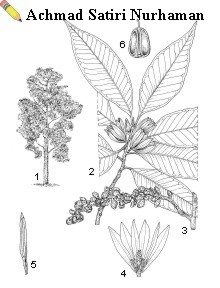 | Michelia champaca L. — 1, tree habit; 2, flowering twig; 3, infructescence; 4, sectioned flower; 5, stamen; 6, seed. |
Growth and Development
The growth form of Michelia is according to Roux's architectural tree model, which is characterized by a continuously growing monopodial orthotropic trunk with plagiotropic branches. Michelia champaca grows well in cultivation and can reach a height of 27 m with a trunk diameter of 55 cm in 27 years; the mean annual increment is 1—1.8 m in height and 1.5—2 cm in diameter. Flowering starts when the tree is 4—5 years old. In intensive cultivation, M. xalba starts flowering 1 year after planting. In Indonesia M. xalba, Michelia champaca and Michelia figo flower year-round; in India Michelia champaca flowers during hot, rainy weather, and bears seed in August. Michelia flowers are protogynous and are pollinated by beetles which feed on the stigmas, pollen, nectar and secretion of the petals. Natural regeneration is usually abundant. Vesicular-arbuscular mycorrhizae have been observed on Michelia champaca roots in India.
Other Botanical Information
M. xalba is only known from cultivation and does not produce fruits. It is thought that it has arisen by hybridization between Michelia champaca and Michelia montana Blume because morphologically it is intermediate between those 2 species. As Michelia montana is confined to Malesia, M. xalba most probably originated in Malesia, possibly in Java where Michelia montana and Michelia champaca are common species with wild and cultivated representatives.
As a result of its wide distribution and its long history of cultivation throughout the tropics, Michelia champaca is very variable. It is subdivided into 2 varieties:
— var. champaca: tree, up to 30 m tall and 50 cm in trunk diameter; petiole with a long stipular scar, at least up to half its length, sometimes over its whole length; leaf blade ovate with cuneate-attenuate base and usually a long acumen at apex. It is cultivated throughout the tropics, possibly originating from India where it is cultivated on the temple grounds of Jains and Hindus.
— var. pubinervia (Blume) Miquel: tree, up to 50 m tall and 1.8 m in trunk diameter; stipular scar on the petiole usually shorter, ranging from 0.3—0.7 times its length; leaf blade elliptical with cuneate to rounded base and a short, oblique acumen at apex. In the wild it occurs in evergreen primary forest on fertile soil in Peninsular Malaysia, Sumatra, Java and the Lesser Sunda Islands (Sumbawa). This variety is also easily cultivated for its valuable wood in Java.
Ecology
In general Michelia is found scattered in primary lowland to montane rain forest, up to 2100 m altitude. M. xalba is usually grown below 1000 m altitude. Michelia champaca occurs in humid tropical evergreen forest or at the edge of forest on deep fertile soils at 250—1500 m altitude, in Java mostly between 1000—1200 m. Mean maximum temperature of the hottest month ranges from 35—40°C, the mean minimum temperature of the coldest month from 3—10°C.
Propagation and planting
As M. xalba does not produce seed, it is propagated vegetatively, usually by marcotting. Methods for micropropagation of M. xalba using tissue culture have been developed in the Philippines. Michelia champaca is easily raised from seed, which germinates in about 3 months after sowing. Stump planting has been successful in some places. Propagation by cuttings is also used, and trees coppice well. Grafting is also possible. In Nepal and India Michelia champaca is planted in the rainy season in nurseries. The fleshy aril contains a powerful germination inhibitor and has to be removed before planting. Seed can be stored for several months: for 7 months under moist conditions at 5°C; for about 4 months in a pit at about 13°C. Other reports indicate that the oil in the seed may deteriorate fairly rapidly, resulting in a rapid loss of viability (within 2 weeks). Seedlings 12—15 months old are usually converted into stumps with a diameter of at least 1.5 cm before planting in the field. In Java planting distance is 3 m x 2.5—3 m, making a cover crop or regular weeding necessary. In the lowland area around Bangkok (Thailand) plantings of M. xalba and Michelia champaca are made on raised beds. Planting is carried out in March—April before the onset of the rainy season. Plant spacing is about 4 m x 6 m. After planting, daily watering or rain is required until the seedlings are well established.
In Vitro Production of Active Compounds
Tissue culture of M. xalba using callus obtained from petal tissue for secondary metabolite production has given promising results in the Philippines.
Husbandry
Although Michelia is widely cultivated, little information is available on its husbandry. For flower production ample watering is needed except during the rainy season. On very dry days water may be applied twice. In the area around Bangkok farmyard manure is applied once per year and NPK fertilizer (e.g. 15-15-15) is given very frequently. The amount of fertilizer applied varies. Old trees of M. xalba are replaced after 10—15 years, those of Michelia champaca after 5—6 years. However, with intensive management Michelia champaca can remain productive for 9—10 years. Michelia champaca is susceptible to fire and intolerant of air pollution when planted as a roadside tree.
Diseases and Pests
In India Michelia champaca is affected by the fungus Phomopsis micheliae causing a leaf spot disease. Rhizoctonia solani causes a leaf spot disease in seedlings; it can be controlled by removing affected seedlings and weeding during humid periods. Michelia champaca is sometimes attacked by caterpillars and grasshoppers but they are easily controlled. The Lepidoptera Papilio argamemnon (green caterpillar) and Ploneta diducta have been found on Michelia champaca in Indonesia. The scale insect Icerya pulcher attacks Michelia champaca in Peninsular Malaysia. In Thailand caterpillars and mealy bugs occasionally cause some damage to leaves and flowers.
Harvesting
In Central Java flowers of M. xalba are only harvested when market conditions are favourable. The flowers are picked by hand or by using a long stick with a hook at the end if the trees are tall. Picking is done once or twice per week. In Thailand harvesting is done daily when trees are in bloom. M. xalba flowers are collected at 8—9 p.m. and are kept in cooled storage until the next morning; flowers of Michelia champaca are picked at 2—3 a.m. The flowers arrive in the markets in Bangkok very early in the morning.
Yield
In Thailand the flower yield of M. xalba is about 50 flowers per day; that of Michelia champaca about 70 flowers per day. No information is available on essential oil yield.
Handling After Harvest
The essential oil from Michelia is obtained by solvent extraction of fresh flowers. It is necessary to process flowers rapidly because only a few hours after picking they turn brown and begin to lose their fragrance, yielding an oil with a less agreeable scent. Enfleurage has also been used to collect the aroma compounds from the flowers. The essential oil from the leaves is obtained by distillation.
Genetic Resources and Breeding
In Arunachal Pradesh (India) a germplasm bank with 33 clones and 2 seed orchards with 25 clones each of Michelia champaca have been established. No breeding programmes exist, however.
Prospects
Michelia essential oils are characterized by their complex rich fragrance and remain sought after for the composition of high quality perfumes. Strict quality control is essential to maintain market interest.
Literature
Ashton, P.M.S., Gunatilleke, I.A.U.N. & Gunatilleke, C.V.S., 1995. Thinning guidelines for tree species of different successional status. Journal of Tropical Forest Science 8: 44—52.
Bahuguna, V.K. & Dhawan, V.K., 1990. Growth performance of Dalbergia sissoo, Eucalyptus grandis, Michelia champaca, Grevillea robusta, Bauhinia variegata and Bauhinia purpurea for planting under social forestry programmes. Indian Forester 116: 609—617.
Dasuki, U.A., 1998. Michelia L. In: Sosef, M.S.M., Hong, L.T. & Prawirohatmodjo, S. (Editors): Plant Resources of South-East Asia No 5(3). Timber trees: Lesser-known timbers. Backhuys Publishers, Leiden, the Netherlands. pp. 376—378.
Mandal, B. & Maity, C.R., 1992. Physicochemical and nutritional characteristics of Michelia champaca seed oil. Acta Alimentaria 21: 131—135.
Nooteboom, H.P., 1988. Magnoliaceae. Michelia. In: de Wilde, W.J.J.O. (Editor): Flora Malesiana, Series 1, Vol. 10. Kluwer Academic Publishers, Dordrecht, the Netherlands. pp. 598—605.
Phondi, O., 1993. Champi-champa [Michelia xalba and M. champaca]. Kasikon 66 (6): 556—558.
Toda, H., Yamaguchi, K. & Shibamoto, T., 1982. Isolation and identification of banana-like aroma from banana shrub (Michelia figo Spreng.). Journal of Agricultural and Food Chemistry 30: 84—88.
Zhu, L.F., Li, Y.H., Li, B.L., Lu, B.Y. & Xia N.H., 1993. Aromatic plants and essential constituents. Hai Feng Publishing Company, Hong Kong, China. pp. 13—17.
Author(s)
Undang Ahmad Dasuki & Kuswanto MS.
Correct Citation of this Article
Dasuki, U.A. & Kuswanto MS., 1999. Michelia L.. In: L.P.A. Oyen and Nguyen Xuan Dung (Editors): Plant Resources of South-East Asia No 19: Essential-oil plants. PROSEA Foundation, Bogor, Indonesia. Database record: prota4u.org/prosea

All texts are licensed under a Creative Commons Attribution-Noncommercial-Share Alike 3.0 Netherlands License
This license does not include the illustrations (Maps,drawings,pictures); these remain all under copyright.