Record Number
72
PROSEA Handbook Number
13: Spices
Taxon
Curcuma longa L.
Protologue
Sp. pl.: 2 (1753).
Family
ZINGIBERACEAE
Chromosome Numbers
2n = 63 (triploid)
Synonyms
Amomum curcuma Jacq. (1776), Curcuma domestica Valeton (1918).
Vernacular Names
Turmeric (En). Curcuma (Fr). Indonesia: kunyit (Indonesian), kunir (Javanese), koneng (Sundanese). Malaysia: kunyit (Malay), temu kunyit (Malay), tius (Semang). Papua New Guinea: kawawara. Philippines: dilaw (Tagalog), duwaw (Cebuano), kalawag (Ilocano). Burma (Myanmar): nanwin. Cambodia: rômiêt, lômiêt. Laos: khminz khünz. Thailand: khamin (general), khamin-kaeng (northern), khamin-chan (central). Vietnam: ngh[eej], u[aas]t kim.
Origin and Geographic Distribution
The exact origin of turmeric is not known but it is thought to originate from South or South-East Asia, most probably from India. Turmeric is not known in a true wild state although in some places it appears to have become naturalized (e.g. in teak forests in East Java). Turmeric is a sterile triploid and is thought to have arisen by continued selection and vegetative propagation of a hybrid between the diploid wild turmeric (Curcuma aromatica Salisb., 2n = 42, native to India, Sri Lanka and the eastern Himalayas) and some other closely related tetraploid species.
India is considered a centre of domestication and turmeric has been grown there since time immemorial. Turmeric reached China before the 7th Century, East Africa in the 8th Century and West Africa in the 13th Century. It was introduced into Jamaica in the 18th Century. At present turmeric is widely cultivated throughout the tropics, but cultivation on a considerable scale is largely confined to India and South-East Asia.
India is considered a centre of domestication and turmeric has been grown there since time immemorial. Turmeric reached China before the 7th Century, East Africa in the 8th Century and West Africa in the 13th Century. It was introduced into Jamaica in the 18th Century. At present turmeric is widely cultivated throughout the tropics, but cultivation on a considerable scale is largely confined to India and South-East Asia.
Uses
Turmeric is mainly cultivated for its rhizome. The major use of turmeric rhizomes is as a culinary spice. As an important constituent (20-25%) of curry powder it is widely used in Asian dishes. Young shoots and young rhizomes can be eaten fresh as a spicy vegetable. In western countries, ground turmeric is widely used in the food industry, in particular as a colouring agent in processed foods and sauces. It is also applied as a colouring agent in pharmaceuticals, confectionery and textile dyes, and is an excellent cheaper substitute for saffron. Turmeric oil and oleoresin find similar applications as the ground spice. In the United States the regulatory status 'generally recognized as safe' has been accorded to turmeric oil (GRAS 3085) and turmeric oleoresin (GRAS 3087). The maximum permitted level of turmeric oil in fragrances is 1%, but it is now rarely used.
Rhizomes are used in Asia as a cosmetic to beautify the body and face. They are an auspicious article in all religious observances in Hindu households, and have many other in daily life in connection with birth, marriage, and death, and in agriculture. Turmeric rhizomes are part of numerous traditional compound medicines used as stomachic, tonic and blood purifier; mixed with warm milk they are used to cure common cold; juice from fresh rhizomes is applied against many skin infections, whereas a decoction is effective against purulent ophthalmia. Recent research has found pharmaceutical activity against cancer, dermatitis, AIDS, inflammation, high cholesterol levels, and dyspeptic conditions. It also has insecticidal, fungicidal and nematicidal properties. The leaves are used in preparing a special medicinal bread in Nepal and India.
Rhizomes are used in Asia as a cosmetic to beautify the body and face. They are an auspicious article in all religious observances in Hindu households, and have many other in daily life in connection with birth, marriage, and death, and in agriculture. Turmeric rhizomes are part of numerous traditional compound medicines used as stomachic, tonic and blood purifier; mixed with warm milk they are used to cure common cold; juice from fresh rhizomes is applied against many skin infections, whereas a decoction is effective against purulent ophthalmia. Recent research has found pharmaceutical activity against cancer, dermatitis, AIDS, inflammation, high cholesterol levels, and dyspeptic conditions. It also has insecticidal, fungicidal and nematicidal properties. The leaves are used in preparing a special medicinal bread in Nepal and India.
Production and International Trade
Turmeric enters into international trade mainly in the form of cured dried whole rhizomes. Trade in ground turmeric is less important than it used to be. India is the largest producer, with 400 000 t from 130 000 ha and dominates the international trade which is estimated at 20 000 t annually. Other producers in Asia include Bangladesh, Pakistan, Sri Lanka, Taiwan, China, Burma (Myanmar), and Indonesia. It is also cultivated in the Caribbean, and in Central and South America, with Jamaica, Haiti and Peru being the most important producing countries. All Asian producers are heavy consumers as well and some are even net importers whereas non-Asian countries export most of their production.
Trade in turmeric from Asian countries is mainly routed through Singapore. Leading importers are Iran, Sri Lanka, most of the Middle East and North African countries. Taiwan is the main supplier of Japan, whereas Jamaican turmeric goes mainly to the North American market. In the 1980s and 1990s the United States imported about 1850 t turmeric annually, with a value of about US$ 2 million.
Trade in turmeric from Asian countries is mainly routed through Singapore. Leading importers are Iran, Sri Lanka, most of the Middle East and North African countries. Taiwan is the main supplier of Japan, whereas Jamaican turmeric goes mainly to the North American market. In the 1980s and 1990s the United States imported about 1850 t turmeric annually, with a value of about US$ 2 million.
Properties
Per 100 g edible portion ground turmeric contains approximately: water 11-13 g, protein 6-8 g, fat 5-10 g, carbohydrates 60-70 g (main constituent is starch), fibre 2-7 g, ash 3-6 g (K 2.5 g, Ca 180 mg, Fe 40 mg, Mg 190 mg, P 270 mg), ascorbic acid 25 mg. The energy value is about 1500 kJ/100 g. On steam distillation the rhizomes yield 2-7% essential oil which is orange-red and slightly fluorescent. Its major constituents are: turmerone 35%, zingiberene 25% and ar-turmerone 12%. Extraction of the rhizome with ethyl alcohol, acetone or methylene chloride yields 6-10% oleoresin, which contains 35-45% of curcumin (C21H20O6) and its derivatives demethoxycurcumin and bis-demethoxycurcumin. Curcumin gives turmeric the characteristic yellow-orange colour, the essential oil gives it the typical aroma and flavour. The contents of the rhizome are very variable and depend on the site of cultivation, type of cultivar, moment of harvest, method of processing and method of analysis.
As the pigment is extremely sensitive to light, turmeric easily discolours.
The essential oil of turmeric is comprised mainly of oxygenated monoterpenes, with smaller quantities of sesquiterpene hydrocarbons and monoterpene hydrocarbons. The relative contribution of individual components to the aroma and flavour is not well known. The aroma of steam-distilled essential oil differs in character from that of the spice and this is believed to arise from artefact formation during the distillation process. A monograph on the physiological of turmeric oil has been published by the Research Institute for Fragrance Materials (RIFM).
As the pigment is extremely sensitive to light, turmeric easily discolours.
The essential oil of turmeric is comprised mainly of oxygenated monoterpenes, with smaller quantities of sesquiterpene hydrocarbons and monoterpene hydrocarbons. The relative contribution of individual components to the aroma and flavour is not well known. The aroma of steam-distilled essential oil differs in character from that of the spice and this is believed to arise from artefact formation during the distillation process. A monograph on the physiological of turmeric oil has been published by the Research Institute for Fragrance Materials (RIFM).
Adulterations and Substitutes
In India, adulteration is a serious problem in local markets and ground turmeric is more vulnerable to such a practice. It is not uncommon to find turmeric powder locally adulterated with lead chromate, yellow earth, sand, or cheap talc. However, in the international market, concern over possible adulteration relates mainly to the mixing of related Curcuma species containing curcuminoid pigments into turmeric rhizome material. The curcuminoid pigments appear to have a restricted occurrence in nature and have been found in only a small number of the many species of Curcuma. There are three other curcumin-containing species that are of real significance with regard to problems of adulteration: Curcuma xanthorrhiza Roxburgh (Indonesian: temu lawak), Curcuma aromatica (wild turmeric or yellow zedoary) and Curcuma zedoaria (Christmann) Roscoe (zedoary). In the producing countries of Asia these three species are variously used as a source of starch, dyes and in folk medicine and as a substitute for true turmeric (not as a spice but in other applications). Identifying these species by microscopy of ground material is often difficult, particularly if the starch grains and oleoresin cells have been destroyed by boiling. Adulteration of Curcuma longa by Curcuma aromatica or Curcuma zedoaria can be detected by chemical methods from the presence of camphor and camphene, which occur as minor components in the essential oil of the latter two species.
Description
Robust, perennial, erect, strongly tillering herb (often cultivated as an annual), up to 1(-1.5) m tall. Rhizome a fleshy complex with an ellipsoidal primary tuber (about 5 cm x 2.5 cm) at the base of each aerial stem, ringed with the bases of old scale leaves and when mature bearing numerous straight or slightly curved, cylindrical, lateral rhizomes (called fingers), 5-10 cm x 1-1.5 cm, which are again repeatedly branched more or less at right angles, the whole forming a dense clump; rhizomes inside and outside bright orange, young tips white, with a spicy smell when bruised. Roots filiform, tough, sometimes very long, often swollen into an ellipsoidal tuber at the apex (2-4 cm x 1-2 cm). Leafy shoots bearing up to 10, alternate, distichous leaves, surrounded by bladeless sheaths, the conduplicate leaf sheaths forming a short pseudostem; ligule small, semi-annular, reflexed, ciliate, membranous, soon withering; petiole 0.5-10 cm long, broadly furrowed with narrow erect wings along the margins; blade oblong-lanceolate, 7-70 cm x 3-18 cm, base cuneate to rounded, apex acute-caudate, above dark green with a green midrib, below very light green, densely studded with pellucid dots. Inflorescence terminal on a central leafy shoot, erect, spike-like, appearing between the leaf sheaths; peduncle terete, 3-20 cm long, densely hairy, covered by pubescent bladeless sheaths or scales; flower spike cylindrical, 5-20 cm x 3-7.5 cm, bearing numerous, spirally arranged, densely hairy bracts; bracts elliptical-lanceolate, 5-7.5 cm x 2.5 cm, in their lower part (0.3-0.5) adnate to each other, the free upper parts spreading, apex acute, slightly inflexed; the lower bracts light green with white longitudinal streaks or white margins, the larger, upper, sterile bracts (coma) white, sometimes pink-tipped; bracteoles thin, elliptical, up to 3.5 cm long, surrounding the flowers; flowers in cincinni of 2 in axils of bracts, long and narrow, 5-6 cm long, white to yellow-white, opening one at a time; calyx tubular, short, with 3 unequal teeth; corolla tubular at base, upper half much widened and with 3 unequal lobes, white; labellum (central staminode) suborbicular to obovate, 12-17 mm in diameter, with 2 small lateral lobes and a large emarginate central lobe, white with a yellow central streak; lateral staminodes 2, elliptical-oblong, 1 cm x 6 mm, creamy-white; stamen for larger part connate with staminodes, 5-6 mm x 3 mm, anther with a broad curved large spur at base; ovary trilocular with 2 erect glands (stylodes) at top; style slender, passing between and held by the anther thecae; stigma expanded. Fruit never produced.
Image
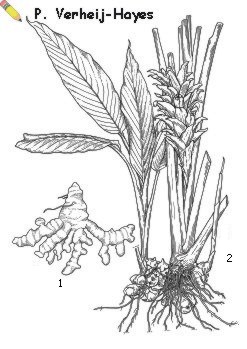 | Curcuma longa L. – 1, rhizome; 2, habit flowering clump |
Growth and Development
In the phase of establishment, sprouting of sets of turmeric is completed in 2-4 weeks, followed by a period of active vegetative growth. Flowering and rhizome development start about 5 months after planting. Active rhizome development continues until the crop is ready for lifting when the lower leaves turn yellow, at about 7-10 months, depending upon cultivar and climatic conditions.
Other Botanical Information
The correct naming of turmeric has long been debated; now Curcuma longa L. is generally accepted. In some countries, especially India, several unofficially recorded cultivars are distinguished by the names of the localities in which they are grown, some forms being preferred for spice use (e.g. Madras type), others for dyeing (e.g. Bengal type). A thorough revision is needed to establish reliable cultivar groups and cultivars. The identity of Curcuma longa as a species also needs better investigation. In Asia a group of closely related species is now distinguished solely by the different colours of the bracts, corolla, leaves or rhizomes and in fact forms one complex species around Curcuma longa. Other taxa of the complex are: Curcuma brog Valeton, Curcuma colorata Valeton, Curcuma euchroma Valeton (Prosea 12), Curcuma montana Roxb. (Prosea 9), Curcuma ochrorhiza Valeton, Curcuma purpurascens Blume (Prosea 12), Curcuma soloensis Valeton (Prosea 12) and Curcuma viridiflora Roxb.
Ecology
Turmeric requires warm and moist conditions. It can be cultivated in most areas of the tropics and subtropics provided rainfall is adequate (1000-2000 mm) or facilities for irrigation are available. A well-distributed rainfall of 1200-1400 mm in 100-120 days is ideal. Cultivation has been extended into areas with over 2000 mm rainfall. It is grown up to altitudes of 1200 m in the Himalayan foothills but it performs better at altitudes of 450-900 m. Temperature ranges of 30-35°C during sprouting, 25-30°C during tillering, 20-25°C during rhizome initiation and 18-2O°C during bulking stage have been identified as optimal. Though turmeric is grown in various soil types, well-drained, loose and friable, fertile loam or clay loam, with good organic matter status, in the pH range of 5-7.5 is preferred. It cannot stand waterlogging and alkaline soils. Gravelly, stony and heavy soils are unsuitable for the development of rhizomes. As a sciophyte it does well in partial shade and can be cropped under fruit trees.
Propagation and planting
Turmeric is propagated vegetatively by rhizomes. Mother rhizomes, whole or cut into pieces, and daughter rhizomes (fingers) are generally used. As seed material mother rhizomes are better than daughter rhizomes. However, it has also been stated that large daughter rhizomes germinate better and produce higher yields than mother rhizomes. Finger rhizomes store better, are more tolerant of wet soil conditions and can be planted at a lower density. It is necessary to store seed rhizomes for 2-3 months from harvest to planting. This may be done by spreading them thinly under a covering of turmeric leaves or storing them in heaps under a layer of straw and soil.
The field should be well prepared by ploughing or digging and turning over to a depth of about 30 cm, to provide a good tilth. Large quantities of organic manure (farmyard manure, oil-seed cake, green leaves) are usually applied. The optimum is reported to be about 25 t/ha of cattle manure or compost and 65 kg/ha of N through oil-seed cake.
Turmeric is generally planted by one of two methods: the flat-bed method or the ridge and furrow method. The flat-bed method is generally better, but in sites with excessive or deficient moisture the ridge and furrow method is superior, facilitating drainage and irrigation. Ridges should be 20-25 cm high and 45-50 cm wide and the rhizomes planted at a distance of 30-40 cm, at a depth of 7.5 cm, with a seed rate of 1.7-2.0 t/ha. A spacing of 25 cm x 25 cm for the flat-bed method is optimal, a seed rate of 2.5 t/ha being recommended. However, good results have been obtained at spacings of 30 cm x 15 cm and 15 cm x 15 cm. If turmeric is intercropped, spacing is adjusted accordingly. Planting time depends on cultivar, planting material and agroclimatic conditions.
Rapid multiplication of turmeric has also been reported using in vitro culture of young vegetative buds excised from sprouting rhizomes. Plantlet formation occurred throughout the year without exhibiting the usual dormancy period of field-grown plants.
The field should be well prepared by ploughing or digging and turning over to a depth of about 30 cm, to provide a good tilth. Large quantities of organic manure (farmyard manure, oil-seed cake, green leaves) are usually applied. The optimum is reported to be about 25 t/ha of cattle manure or compost and 65 kg/ha of N through oil-seed cake.
Turmeric is generally planted by one of two methods: the flat-bed method or the ridge and furrow method. The flat-bed method is generally better, but in sites with excessive or deficient moisture the ridge and furrow method is superior, facilitating drainage and irrigation. Ridges should be 20-25 cm high and 45-50 cm wide and the rhizomes planted at a distance of 30-40 cm, at a depth of 7.5 cm, with a seed rate of 1.7-2.0 t/ha. A spacing of 25 cm x 25 cm for the flat-bed method is optimal, a seed rate of 2.5 t/ha being recommended. However, good results have been obtained at spacings of 30 cm x 15 cm and 15 cm x 15 cm. If turmeric is intercropped, spacing is adjusted accordingly. Planting time depends on cultivar, planting material and agroclimatic conditions.
Rapid multiplication of turmeric has also been reported using in vitro culture of young vegetative buds excised from sprouting rhizomes. Plantlet formation occurred throughout the year without exhibiting the usual dormancy period of field-grown plants.
Husbandry
After planting it is beneficial to mulch with leaves of Sesbania spp., Crotalaria spp., Shorea spp., or Dalbergia spp., with sugarcane trash or other locally available leaves or straw. This practice improves rhizome establishment, suppresses weeds and increases plant height and rhizome yield. It is recommended to apply a mulch of green leaves twice at a rate of 15 t/ha, at planting and 60 days after planting.
After-planting care consists of weeding, irrigation, protection against diseases and pests, and application of fertilizers. Early weeding may be avoided by the use of 2,4-D as a pre-emergence herbicide. Three to four hoeings followed by weeding at regular intervals are desirable. Earthing-up may be necessary about 8 weeks after planting.
A good soaking of the field at planting is beneficial, followed by a weekly irrigation until sprouting is completed, after which less frequent watering will be required.
Turmeric, being an exhaustive crop, requires heavy manuring for high yield. Under rainfed conditions the application of ammonium sulphate at a rate of 100 kg/ha has been reported to increase yield by nearly 100%. Response to phosphorus at a rate of up to 175 kg/ha and in combination with other nutrients has also been reported. Application of potassium significantly increases plant height, and the number of tillers, leaves, and mother and daughter rhizomes. Among micronutrients, responses to iron and zinc have been reported (50 kg each of FeSO¦ and ZnSO¦). However, recommendations of fertilizer application differ widely from place to place.
After-planting care consists of weeding, irrigation, protection against diseases and pests, and application of fertilizers. Early weeding may be avoided by the use of 2,4-D as a pre-emergence herbicide. Three to four hoeings followed by weeding at regular intervals are desirable. Earthing-up may be necessary about 8 weeks after planting.
A good soaking of the field at planting is beneficial, followed by a weekly irrigation until sprouting is completed, after which less frequent watering will be required.
Turmeric, being an exhaustive crop, requires heavy manuring for high yield. Under rainfed conditions the application of ammonium sulphate at a rate of 100 kg/ha has been reported to increase yield by nearly 100%. Response to phosphorus at a rate of up to 175 kg/ha and in combination with other nutrients has also been reported. Application of potassium significantly increases plant height, and the number of tillers, leaves, and mother and daughter rhizomes. Among micronutrients, responses to iron and zinc have been reported (50 kg each of FeSO¦ and ZnSO¦). However, recommendations of fertilizer application differ widely from place to place.
Diseases and Pests
Leaf spot or leaf blotch, and rhizome rot are considered the most important diseases of turmeric. Leaf spot or leaf blotch, caused by Taphrina malucans, is characterized by the appearance of spots on both surfaces of the leaves, 1-2 mm in diameter, coalescing freely. Infected leaves are distorted, have a reddish brown appearance and soon become yellow. The disease can be controlled reasonably by Bordeaux mixture, ethion, and zineb. Cultivars resistant to the disease are available.
Another leaf spot disease is caused by Colletotrichum capsici, provoking spots of variable size, enlarging to 4-5 cm x 3 cm and frequently coalescing over most of the leaf, which then dries up. In very severe infection most leaves dry up, presenting a scorched appearance, resulting in yield losses of more than 50%. The disease can be checked by spraying Bordeaux mixture once before symptoms appear. Captan and zineb, applied at monthly intervals, control the disease adequately. Planting materials should be selected from disease-free areas and treated with an authorized fungicide before planting. Excess shade and intercropping favour the disease.
Rhizome rot caused by Pythium aphanidermatum shows progressive drying-up of the leaves of infected plants. The base of the aerial shoots shows water-soaked soft lesions. As the disease progresses infection gradually passes to the rhizomes, which begin to rot and become soft. The bright orange colour of the rhizomes changes into brown. The disease may be confined to a few isolated plants or may occur in patches. In severe attacks the yield is considerably reduced. One of the effective control methods is eradication and burning of infected plants. In serious cases it may be advisable to disinfect the soil with an authorized fungicide. Incorporation of 1% urea into the infected soil may reduce the infection.
Pests of turmeric include shoot borers, leaf-eating insects, sucking insects and nematodes. Caterpillars of the shoot borer Dichocrocis punctiferalis bore into the shoot, causing the central shoot to die ('dead heart'). Monthly spraying with malathion controls the insect. The hesperiid caterpillar Udaspes folus is also a serious foliage feeding insect. It is recommended to spraying carbaryl, dimethoate or phosphamidon for its control.
The scale insect Aspidiotus hartii is a sucking insect infesting rhizomes while still in the field. It multiplies on the fresh rhizomes being kept for seed. The infested rhizomes ultimately desiccate. Control is achieved by dipping the seed rhizomes in phosalone, monocrotophos or quinalphos. Two hymenopteran parasites, Physcus sp. and Adelencyrtus moderatus, attack this insect pest.
The tinged bug, Stephanitis typicus, causes leaf discolouration by sucking the sap. Thrips also suck the leaves, which then roll up, turn pale and gradually dry up. The nematodes recorded in turmeric include root-knot nematode (Meloidogyne incognita) and burrowing nematode (Radopholus similis).
Another leaf spot disease is caused by Colletotrichum capsici, provoking spots of variable size, enlarging to 4-5 cm x 3 cm and frequently coalescing over most of the leaf, which then dries up. In very severe infection most leaves dry up, presenting a scorched appearance, resulting in yield losses of more than 50%. The disease can be checked by spraying Bordeaux mixture once before symptoms appear. Captan and zineb, applied at monthly intervals, control the disease adequately. Planting materials should be selected from disease-free areas and treated with an authorized fungicide before planting. Excess shade and intercropping favour the disease.
Rhizome rot caused by Pythium aphanidermatum shows progressive drying-up of the leaves of infected plants. The base of the aerial shoots shows water-soaked soft lesions. As the disease progresses infection gradually passes to the rhizomes, which begin to rot and become soft. The bright orange colour of the rhizomes changes into brown. The disease may be confined to a few isolated plants or may occur in patches. In severe attacks the yield is considerably reduced. One of the effective control methods is eradication and burning of infected plants. In serious cases it may be advisable to disinfect the soil with an authorized fungicide. Incorporation of 1% urea into the infected soil may reduce the infection.
Pests of turmeric include shoot borers, leaf-eating insects, sucking insects and nematodes. Caterpillars of the shoot borer Dichocrocis punctiferalis bore into the shoot, causing the central shoot to die ('dead heart'). Monthly spraying with malathion controls the insect. The hesperiid caterpillar Udaspes folus is also a serious foliage feeding insect. It is recommended to spraying carbaryl, dimethoate or phosphamidon for its control.
The scale insect Aspidiotus hartii is a sucking insect infesting rhizomes while still in the field. It multiplies on the fresh rhizomes being kept for seed. The infested rhizomes ultimately desiccate. Control is achieved by dipping the seed rhizomes in phosalone, monocrotophos or quinalphos. Two hymenopteran parasites, Physcus sp. and Adelencyrtus moderatus, attack this insect pest.
The tinged bug, Stephanitis typicus, causes leaf discolouration by sucking the sap. Thrips also suck the leaves, which then roll up, turn pale and gradually dry up. The nematodes recorded in turmeric include root-knot nematode (Meloidogyne incognita) and burrowing nematode (Radopholus similis).
Harvesting
Turmeric is ready for harvest 7-10 months after planting, when the lower leaves turn yellow. Harvesting is done by digging. Care should be taken not to damage the rhizomes and to ensure that the whole clump is lifted together with the dry plant. Leafy tops are then cut off, roots and adhering earth removed, and rhizomes are well washed. The finger rhizomes are separated from the mother rhizome. A few rhizomes may be used fresh and, except for those that are required for replanting, the remainder are processed.
Yield
The average yield of fresh turmeric rhizomes is 17-23 t/ha if the crop is irrigated, and 6.5-9.0 t/ha under rainfed conditions. However, yields depend largely upon the cultivar. Some cultivars are capable of yielding 30-35 t/ha of fresh turmeric.
Handling After Harvest
To develop the attractive yellow colour and the characteristic aroma, the cleaned rhizomes are cooked in boiling water for 1 hour under slightly alkaline conditions. The cooked material is dried in the sun for 6-8 days. Hot-air dryers are also used. Dried rhizomes are polished to smoothe their exterior and also to slightly improve the colour. The polishing can be done in a simple rotating cylindrical galvanized iron drum turned by hand, or in other types of equipment. A small quantity of turmeric powder sprinkled in during polishing gives the product a good appearance.
Genetic Resources and Breeding
A germplasm collection of 500-600 turmeric accessions is maintained in India. The average productivity and quality of turmeric are far from being satisfactory. Until recently, there has been hardly any work on crop improvement, because conventional methods of breeding are hampered by problems of sterility. Clonal selection is now being applied to exploit the naturally occurring variation, and mutation breeding is being practised. The major breeding objectives are high yield and resistance against rhizome rot.
Prospects
Tumeric is an important spice in India and South-East Asia. The growing demand for turmeric as a spice and as a safe food colouring agent in local as well as international markets indicates that its prospects are good. Crop improvement, agronomic research and pest management need to be undertaken to obtain high production levels and good quality. Studies on the bioactive compounds of the rhizomes have opened up new possibilities for the use of turmeric in pharmaceutical products. Given the dominant position of India in both production and trade, it will be difficult for the crop to expand in South-East Asia for the international market. Expansion for local use may offer better opportunities.
Literature
Burkill, I.H., 1966. A dictionary of the economic products of the Malay Peninsula. Revised reprint of the 1935 edition. Ministry of Agriculture and Cooperatives, Kuala Lumpur, Malaysia. pp. 714-725.
Burtt, B.L., 1977. The nomenclature of turmeric and other Ceylon Zingiberaceae. Notes Royal Botanic Garden Edinburgh 35: 209-215.
Chadha, K.L. & Rethinam, P. (Editors), 1994. Advances in horticulture. Plantation and spice crops Part 1. Malhotra Publishing House, New Delhi, India. Vol. 9: pp. 131-150, 315-323. Vol. 10: pp. 1245-1248.
George, C.K., 1994a. Spice industry: a domestic and global overview. Indian Horticulture 39(3): 17-19.
George, C.K., 1994b. Ensuring quality in spice exports: example of India. International Trade Forum 2: 14, 30.
Husain, F., 1992. Spices: trends on the world market. International Trade Forum, October-December 1992. pp. 14-15.
Nadgauda, R.S., Mascarenhas, A.F., Hendre, R.R. & Jagannathan, V., 1978. Rapid multiplication of turmeric (Curcuma longa Linn.) plants by tissue culture. Indian Journal of Experimental Biology 16(1): 120-122.
Nair, M.K., Premkumar, T., Ravindran, P.N. & Sharma, Y.R. (Editors), 1982. Ginger and turmeric. Proceedings of the National Seminar on Ginger and Turmeric, Kerala, India.
Purseglove, J.W., Brown, E.G., Green, C.L. & Robbins, S.R.J., 1981. Spices. Vol. 2. Longman, Harlow, Essex, United Kingdom. pp. 532-580.
Rethinam, P., Sivaraman, K. & Sushama, P.K., 1994. Nutrition of turmeric. In: Chadha, K.L. & Rethinam, P. (Editors): Advances in horticulture. Plantation and spice crops Part 1. Vol. 9. Malhotra Publishing House, New Delhi, India. pp. 477-490.
Burtt, B.L., 1977. The nomenclature of turmeric and other Ceylon Zingiberaceae. Notes Royal Botanic Garden Edinburgh 35: 209-215.
Chadha, K.L. & Rethinam, P. (Editors), 1994. Advances in horticulture. Plantation and spice crops Part 1. Malhotra Publishing House, New Delhi, India. Vol. 9: pp. 131-150, 315-323. Vol. 10: pp. 1245-1248.
George, C.K., 1994a. Spice industry: a domestic and global overview. Indian Horticulture 39(3): 17-19.
George, C.K., 1994b. Ensuring quality in spice exports: example of India. International Trade Forum 2: 14, 30.
Husain, F., 1992. Spices: trends on the world market. International Trade Forum, October-December 1992. pp. 14-15.
Nadgauda, R.S., Mascarenhas, A.F., Hendre, R.R. & Jagannathan, V., 1978. Rapid multiplication of turmeric (Curcuma longa Linn.) plants by tissue culture. Indian Journal of Experimental Biology 16(1): 120-122.
Nair, M.K., Premkumar, T., Ravindran, P.N. & Sharma, Y.R. (Editors), 1982. Ginger and turmeric. Proceedings of the National Seminar on Ginger and Turmeric, Kerala, India.
Purseglove, J.W., Brown, E.G., Green, C.L. & Robbins, S.R.J., 1981. Spices. Vol. 2. Longman, Harlow, Essex, United Kingdom. pp. 532-580.
Rethinam, P., Sivaraman, K. & Sushama, P.K., 1994. Nutrition of turmeric. In: Chadha, K.L. & Rethinam, P. (Editors): Advances in horticulture. Plantation and spice crops Part 1. Vol. 9. Malhotra Publishing House, New Delhi, India. pp. 477-490.
Author(s)
K.R. Dahal & S. Idris
Correct Citation of this Article
Dahal, K.R. & Idris, S., 1999. Curcuma longa L.. In: de Guzman, C.C. and Siemonsma, J.S. (Editors): Plant Resources of South-East Asia No 13: Spices. PROSEA Foundation, Bogor, Indonesia. Database record: prota4u.org/prosea

All texts are licensed under a Creative Commons Attribution-Noncommercial-Share Alike 3.0 Netherlands License
This license does not include the illustrations (Maps,drawings,pictures); these remain all under copyright.