Record Number
930
PROSEA Handbook Number
12(2): Medicinal and poisonous plants 2
Taxon
Ayapana triplinervis (Vahl) R.M. King & H. Robinson
Protologue
Phytologia 20(3): 212 (1970).
Family
COMPOSITAE
Chromosome Numbers
2n = 51 (triploid)
Synonyms
Eupatorium triplinerve Vahl (1794), Eupatorium ayapana Vent. (1803).
Vernacular Names
White snakeroot, pool root (En). Ayapana (Fr). Indonesia: acerang (Malay), jukut prasman (Sundanese), rajapanah (Javanese). Philippines: apana, ayapana (Tagalog), impana (Iloko). Vietnam: b[ar] d[ooj]t, c[af] d[os]t.
Origin and Geographic Distribution
Ayapana triplinervis originated in the area from northern Brazil to Suriname, and was introduced, cultivated and naturalized long ago in some Caribbean islands, Africa, India, Indo-China, the Philippines, and Java, from where it was introduced into other parts of Indonesia.
Uses
Ayapana triplinervis plants smell strongly of coumarin, especially when crushed, and has a taste which is both bitter and aromatic. It is widely used as a tea in the whole of its distribution area, against chronic diarrhoea, as a stimulant, a sudorific and a tonic, and against badly infected wounds, thrush, lung diseases and as an antidote for snake bites. In small doses it is a stimulant and tonic, but when taken in larger quantities it is laxative. Because of its haemostatic properties it is used to regulate menstruation problems. A water extract of the dried leaves and shoots is used as a cardiac stimulant, increasing the force of the heart beat but diminishing its frequency. In Cambodia, it is recommended that young mothers inhale the scent of the leaves to gain strength and colour. In Brazil and the Caribbean, a gargle prepared from the leaves is used to relieve thrush, scurvy and angina. In Trinidad, a decoction is taken internally or used for bathing as a remedy for influenza, chest colds, pneumonia and constipation.
In Indonesia and Africa, Ayapana triplinervis is also used as an excellent ground cover in tea and rubber plantations. In Suriname, the leaves are used for flavouring turtle meat. It is cultivated in Brazil for its essential oil, which is used in perfumes. In 19th century France, a leaf decoction was widely used as a substitute for tea, because of its spicy taste.
In Indonesia and Africa, Ayapana triplinervis is also used as an excellent ground cover in tea and rubber plantations. In Suriname, the leaves are used for flavouring turtle meat. It is cultivated in Brazil for its essential oil, which is used in perfumes. In 19th century France, a leaf decoction was widely used as a substitute for tea, because of its spicy taste.
Properties
The leaves of Ayapana triplinervis contain ayapanine (7-methoxycoumarin) which has a distinct coumarin-like odour, and ayapine (6,7-methylenedioxycoumarin). Both compounds have excellent haemostatic properties, applied locally, as a tea or subcutaneously. Ayapanine and ayapine are generally non-toxic when administered locally or taken orally; moreover, they have no effect on respiration or on blood pressure. Further known constituents of the leaves include the terpenes phellandrene, borneol, 'BETA'-selinene, the quinones thymoquinone and thymoquinone-dimethylether, carotene and vitamin C (0.025%).
Using the filter paper disk assay, the essential oil isolated from Ayapana triplinervis was shown to inhibit the growth of certain fungi (Curvularia spp., Rhizopus spp., Aspergillus spp. and Penicillium spp.), but not that of Aspergillus fumigatus and Penicillium decumbens. Furthermore, the essential oil showed high activity against the bacteria Escherichia coli and Proteus vulgaris, and moderate activity against Bacillus anthracis, Staphylococcus aureus and some Salmonella spp.
A laboratory study showed strong feeding rejection by caterpillars of Diacrisia obliqua, Philosamia ricini, Trabala vishnou and Pshissama transiens on Ricinus communis L. leaves which had been sprayed with 7-methoxycoumarin. Also, a methanol extract of Ayapana triplinervis, used as an insecticide against the paddy brown plant hopper (Nilaparvata lugens), caused about 42% mortality of adult female grass hoppers.
Using the filter paper disk assay, the essential oil isolated from Ayapana triplinervis was shown to inhibit the growth of certain fungi (Curvularia spp., Rhizopus spp., Aspergillus spp. and Penicillium spp.), but not that of Aspergillus fumigatus and Penicillium decumbens. Furthermore, the essential oil showed high activity against the bacteria Escherichia coli and Proteus vulgaris, and moderate activity against Bacillus anthracis, Staphylococcus aureus and some Salmonella spp.
A laboratory study showed strong feeding rejection by caterpillars of Diacrisia obliqua, Philosamia ricini, Trabala vishnou and Pshissama transiens on Ricinus communis L. leaves which had been sprayed with 7-methoxycoumarin. Also, a methanol extract of Ayapana triplinervis, used as an insecticide against the paddy brown plant hopper (Nilaparvata lugens), caused about 42% mortality of adult female grass hoppers.
Description
A perennial, tufted, glabrous, aromatic herb, 35—100(—150) cm tall; stem reddish, often partly decumbent, rooting at the lower nodes; young shoots often whitish, because of resinous exudate. Leaves opposite, on flowering stems partially alternate, simple, lanceolate to narrowly oblong, 3—12 cm x 0.5—2.5 cm, base gradually tapering, apex obtuse, margins entire, recurved, or with a few minute teeth, blade rather thick, lowermost opposite pair of lateral veins arising above the leaf-base, dark green or tinged purple to a varying extent; petiole 0—10 cm long; stipules absent. Inflorescence a head, many arranged together in a lax terminal corymb; involucre campanulate, bracts very acute, green with purple tips, finely pubescent, heads 6—7 mm long, 20(—50)-flowered. Flowers all tubular, corolla scarcely exerted from the involucre, narrowly funnel-shaped, 3.5—5 mm long, glabrous on inner surface, with glands on outer surface of lobes, reddish-violet, with a greenish-white base; anthers 5, very loosely cohering or finally free; ovary inferior; style base enlarged, glabrous, style branches filiform, appendages fimbriate. Fruit a narrowly oblong achene, 2 mm long, 5-angled and sparsely hairy on the angles; pappus 3 mm long, white.
Image
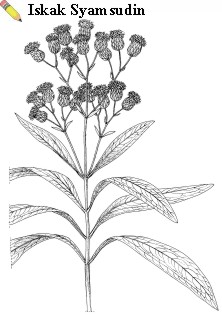 | Ayapana triplinervis (Vahl) R.M. King & H. Robinson - flowering stem |
Growth and Development
Ayapana triplinervis forms large clumps of unbranched stems which grow throughout the year, but especially during the rainy season. It rarely flowers in Java, and when flower heads appear, achenes apparently never develop, probably because the species is triploid.
Other Botanical Information
Ayapana is primarily a South American genus of 14 species, with a few widely distributed species such as Ayapana triplinervis, which originates from northern Brazil to Suriname. Ayapana is one of the most natural groups in the tribe Eupatorieae, and is different from the other groups because of its fimbriate style appendages and the enlarged base of the fruit stalk. The red-flowered variety of Ayapana triplinervis is medicinally most active.
Ecology
Ayapana triplinervis endures heavy shade, and has excellent ground-covering and soil retaining properties. It grows from sea-level up to 1600 m altitude. The flowering time in Brazil is from June to December.
Propagation and planting
In Java, Ayapana triplinervis is often planted in the hills, near local houses and remains long after these houses are gone. It is propagated through division.
Harvesting
Ayapana triplinervis leaves are picked from the gardens whenever the need arises.
Genetic Resources and Breeding
As a result of vegetative propagation, the genetic variability within cultivated Ayapana triplinervis seems to be rather small in Indonesia. No germplasm collections or breeding programmes are known to exist.
Prospects
The coumarins and volatile oil constituents of Ayapana triplinervis show interesting activity in the fields of haemostasis and plant protection (antifungal, insecticide), and merit further research.
Literature
Chaurasia, S.C. & Kher, A., 1978. Activity of essential oils of three medicinal plants against various pathogenic and nonpathogenic fungi. Indian Journal of Hospital Pharmacy 15(5): 139—141.
Council of Scientific and Industrial Research, 1952. The wealth of India: a dictionary of Indian raw materials and industrial products. Revised Edition. Vol. 3. Publications and Information Directorate, New Delhi, India. p. 223.
King, R.M. & Robinson, H., 1970. Studies in the Eupatorieae (Compositae). 30. The genus Ayapana. Phytologia 20(3): 210—212.
Mansfeld, R., 1986. Verzeichnis landwirtschaftlicher und gärtnerischer Kulturpflanzen (ohne Zierpflanzen) [Register of agricultural and horticultural plants in cultivation (without ornamentals)]. Schultze-Motel, J. et al., editors 2nd Edition, Vol. 2. Springer Verlag, Berlin, Germany. p. 1265.
Morton, J.F., 1981. Atlas of medicinal plants of Middle America. Bahamas to Yucatan. Charles C. Thomas, Springfield, Illinois, United States. pp. 934—935.
Pételot, A., 1953. Les plantes médicinales du Cambodge, du Laos et du Vietnam. [The medicinal plants of Cambodia, Laos and Vietnam]. Centre National de Recherches Scientifiques et Techniques, Saigon, Vietnam. Vol. 2. pp. 44—45.
Council of Scientific and Industrial Research, 1952. The wealth of India: a dictionary of Indian raw materials and industrial products. Revised Edition. Vol. 3. Publications and Information Directorate, New Delhi, India. p. 223.
King, R.M. & Robinson, H., 1970. Studies in the Eupatorieae (Compositae). 30. The genus Ayapana. Phytologia 20(3): 210—212.
Mansfeld, R., 1986. Verzeichnis landwirtschaftlicher und gärtnerischer Kulturpflanzen (ohne Zierpflanzen) [Register of agricultural and horticultural plants in cultivation (without ornamentals)]. Schultze-Motel, J. et al., editors 2nd Edition, Vol. 2. Springer Verlag, Berlin, Germany. p. 1265.
Morton, J.F., 1981. Atlas of medicinal plants of Middle America. Bahamas to Yucatan. Charles C. Thomas, Springfield, Illinois, United States. pp. 934—935.
Pételot, A., 1953. Les plantes médicinales du Cambodge, du Laos et du Vietnam. [The medicinal plants of Cambodia, Laos and Vietnam]. Centre National de Recherches Scientifiques et Techniques, Saigon, Vietnam. Vol. 2. pp. 44—45.
Other Selected Sources
[74] Backer, C.A. & Bakhuizen van den Brink Jr, R.C., 1964—1968. Flora of Java. 3 volumes. Noordhoff, Groningen, the Netherlands. Vol. 1 (1964) 647 pp., Vol. 2 (1965) 641 pp., Vol. 3 (1968) 761 pp.
[128] Brown, W.H., 1951—1957. Useful plants of the Philippines. Reprint of the 1941—1943 edition. 3 volumes. Technical Bulletin 10. Department of Agriculture and Natural Resources. Bureau of Printing, Manila, the Philippines. Vol. 1 (1951) 590 pp
[134] Burkill, H.M., 1985—2000. The useful plants of West tropical Africa. 2nd Edition. 5 volumes. Royal Botanic Gardens, Kew, United Kingdom. Vol. 1 (1985), Families A—D, 960 pp.; Vol. 2 (1994), Families E—I, 636 pp.; Vol. 3 (1995), Families J—L, 857 pp.; Vol. 4 (1997), Families M—R, 969 pp; Vol. 5 (2000), Families S—Z, 686 pp.
[135] Burkill, I.H., 1966. A dictionary of the economic products of the Malay Peninsula. Revised reprint. 2 volumes. Ministry of Agriculture and Co-operatives, Kuala Lumpur, Malaysia. Vol. 1 (A—H) pp. 1—1240, Vol. 2 (I—Z) pp. 1241—2444.
[275] Dutta, P., Barua, N.C., Chaudhuri, R.P. & Sharma, R.P., 1989. Insect feeding deterrent principle from Eupatorium ayapana Vent. Journal of Research Assam Agricultural University 10(1): 74—77.
[407] Heyne, K., 1950. De nuttige planten van Indonesië [The useful plants of Indonesia]. 3rd Edition. 2 volumes. W. van Hoeve, 's-Gravenhage, the Netherlands/Bandung, Indonesia. 1660 + CCXLI pp.
[410] Hiremath, I.G. & Ahn, Y.J., 1997. Parthenium as a source of pesticide. First International Conference on Parthenium Management, Dharwad, India. pp. 86—89.
[482] Jain, T.C. & Striha, R.J., 1976. Semmler's hydrocarbon from Eupatorium ayapana. Phytochemistry 15(5): 847—848.
[670] Merrill, E.D., 1912. A flora of Manila. Department of the Interior, Bureau of Science, Manila, the Philippines. 491 pp.
[671] Merrill, E.D., 1923—1926. An enumeration of Philippine flowering plants. 4 volumes. Bureau of Printing, Manila, the Philippines.
[735] Nguyen Thi Diem Trang, Wanner, M.J., Le Viet Ngoc Phuong, Koomen, G.J. & Nguyen Xuan Dung, 1993. Thymoquinone from Eupatorium ayapana. Planta Medica 59(1): 99.
[786] Perry, L.M., 1980. Medicinal plants of East and Southeast Asia. Attributed properties and uses. MIT Press, Cambridge, Massachusetts, United States & London, United Kingdom. 620 pp.
[810] Quisumbing, E., 1978. Medicinal plants of the Philippines. Katha Publishing Co., Quezon City, the Philippines. 1262 pp.
[1094] Yadava, R.N. & Saini, V.K., 1990. In vitro antimicrobial efficacy of the essential oil of Eupatorium triplinerve leaves. Indian Perfumer 34(1): 61—63.
[128] Brown, W.H., 1951—1957. Useful plants of the Philippines. Reprint of the 1941—1943 edition. 3 volumes. Technical Bulletin 10. Department of Agriculture and Natural Resources. Bureau of Printing, Manila, the Philippines. Vol. 1 (1951) 590 pp
[134] Burkill, H.M., 1985—2000. The useful plants of West tropical Africa. 2nd Edition. 5 volumes. Royal Botanic Gardens, Kew, United Kingdom. Vol. 1 (1985), Families A—D, 960 pp.; Vol. 2 (1994), Families E—I, 636 pp.; Vol. 3 (1995), Families J—L, 857 pp.; Vol. 4 (1997), Families M—R, 969 pp; Vol. 5 (2000), Families S—Z, 686 pp.
[135] Burkill, I.H., 1966. A dictionary of the economic products of the Malay Peninsula. Revised reprint. 2 volumes. Ministry of Agriculture and Co-operatives, Kuala Lumpur, Malaysia. Vol. 1 (A—H) pp. 1—1240, Vol. 2 (I—Z) pp. 1241—2444.
[275] Dutta, P., Barua, N.C., Chaudhuri, R.P. & Sharma, R.P., 1989. Insect feeding deterrent principle from Eupatorium ayapana Vent. Journal of Research Assam Agricultural University 10(1): 74—77.
[407] Heyne, K., 1950. De nuttige planten van Indonesië [The useful plants of Indonesia]. 3rd Edition. 2 volumes. W. van Hoeve, 's-Gravenhage, the Netherlands/Bandung, Indonesia. 1660 + CCXLI pp.
[410] Hiremath, I.G. & Ahn, Y.J., 1997. Parthenium as a source of pesticide. First International Conference on Parthenium Management, Dharwad, India. pp. 86—89.
[482] Jain, T.C. & Striha, R.J., 1976. Semmler's hydrocarbon from Eupatorium ayapana. Phytochemistry 15(5): 847—848.
[670] Merrill, E.D., 1912. A flora of Manila. Department of the Interior, Bureau of Science, Manila, the Philippines. 491 pp.
[671] Merrill, E.D., 1923—1926. An enumeration of Philippine flowering plants. 4 volumes. Bureau of Printing, Manila, the Philippines.
[735] Nguyen Thi Diem Trang, Wanner, M.J., Le Viet Ngoc Phuong, Koomen, G.J. & Nguyen Xuan Dung, 1993. Thymoquinone from Eupatorium ayapana. Planta Medica 59(1): 99.
[786] Perry, L.M., 1980. Medicinal plants of East and Southeast Asia. Attributed properties and uses. MIT Press, Cambridge, Massachusetts, United States & London, United Kingdom. 620 pp.
[810] Quisumbing, E., 1978. Medicinal plants of the Philippines. Katha Publishing Co., Quezon City, the Philippines. 1262 pp.
[1094] Yadava, R.N. & Saini, V.K., 1990. In vitro antimicrobial efficacy of the essential oil of Eupatorium triplinerve leaves. Indian Perfumer 34(1): 61—63.
Author(s)
G.H. Schmelzer
Correct Citation of this Article
Schmelzer, G.H., 2001. Ayapana triplinervis (Vahl) R.M. King & H. Robinson. In: van Valkenburg, J.L.C.H. and Bunyapraphatsara, N. (Editors): Plant Resources of South-East Asia No 12(2): Medicinal and poisonous plants 2. PROSEA Foundation, Bogor, Indonesia. Database record: prota4u.org/prosea

All texts are licensed under a Creative Commons Attribution-Noncommercial-Share Alike 3.0 Netherlands License
This license does not include the illustrations (Maps,drawings,pictures); these remain all under copyright.